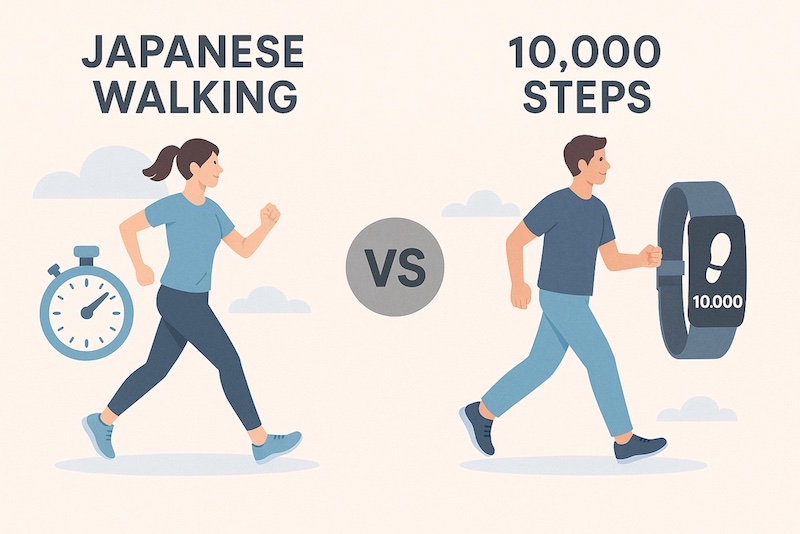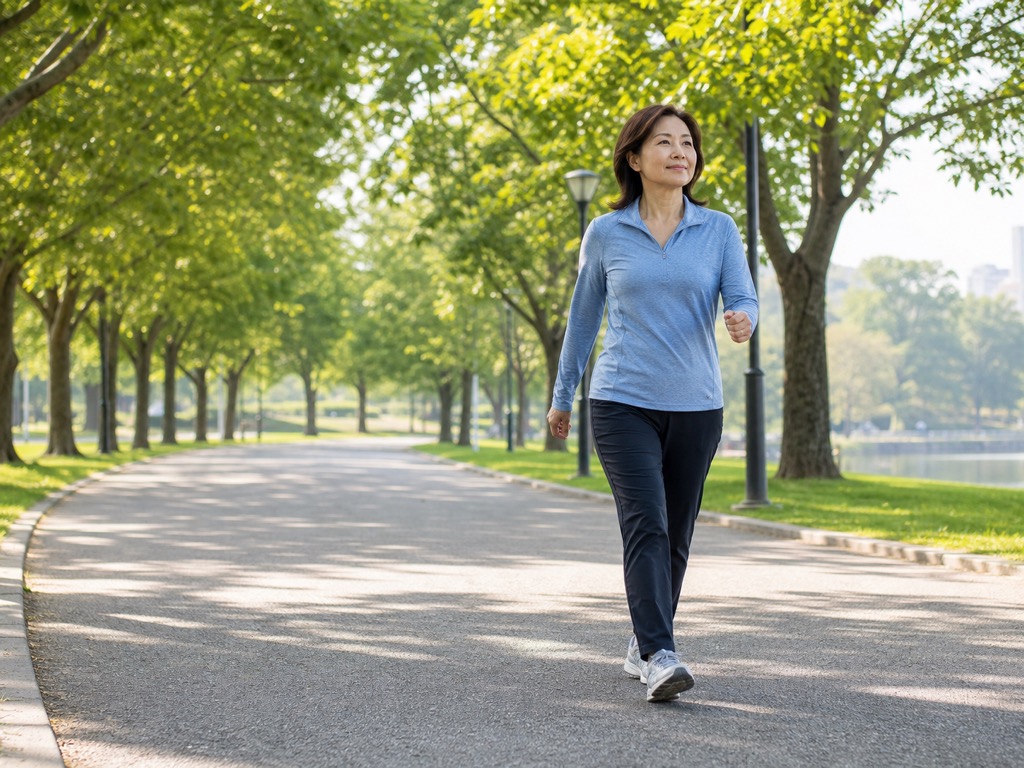
Yes, you can often do Japanese interval walking with bad knees, but the useful word there is often, not always. If your knees hate hills, long descents, twisting, or hard impact, that does not automatically mean interval walking is off the table. It usually means the standard version needs to be softened so the brisk parts still feel purposeful without turning the session into a limp-fest.
The short answer is this: if your knee issue is mild to moderate and walking itself is generally tolerated, Japanese walking can be adapted by using a flatter route, a more moderate brisk pace, shorter work bouts, longer recovery, and stricter pain rules.
If you are new to the method, start with our complete guide to Japanese walking first. It explains the normal 3-minutes-brisk, 3-minutes-easy rhythm. For sore knees, the rhythm stays useful, but the intensity target usually needs more humility. A lot more humility, honestly.
Short answer: Japanese walking can work for bad knees if the knee tolerates walking and you modify the hard part
“Bad knees” can mean a bunch of different things: osteoarthritis, old injuries, front-of-knee pain, stiffness after sitting, or just a knee that gets cranky when you do too much too fast. That matters because no article can diagnose which bucket you are in. Still, the overall evidence points in a pretty practical direction. Walking is commonly recommended as low-impact exercise for people with knee osteoarthritis, and regular physical activity can improve pain, function, mood, and quality of life when it is progressed sensibly. At the same time, pain that becomes sharp, causes limping, or stays worse for hours after exercise is a sign the dose or activity needs to change.
That is exactly why Japanese interval walking can be a decent fit for some people with touchy knees. The easy intervals create built-in recovery. You are not forcing one nonstop brisk effort for 30 straight minutes. In knee osteoarthritis research, walking for exercise has been associated with less frequent new knee pain over time, and one study comparing continuous versus interval walking suggested that built-in breaks may limit pain during exercise. That does not prove interval walking is magic for every knee problem. It does suggest that alternating effort can be more manageable than grinding through one continuous moderate walk.
The catch is simple: the brisk interval should feel brisk for you, not aggressive for social media. If you treat the brisk interval like “a little quicker than easy, but still smooth and controlled,” the workout usually has a better chance.
The best modifications if your knees get irritated easily
Most people with sore knees do better when they change several variables at once instead of obsessing over only speed. The goal is to lower joint irritation while keeping enough contrast between work and recovery that the session still counts as training.
- Use flat ground first. Flat pavement, a track, or a treadmill with little to no incline is usually kinder than hills. Downhill sections are often the sneaky knee irritant.
- Shrink the fast interval. Start with 1 minute brisk and 2 to 3 minutes easy, or 2 minutes brisk and 3 minutes easy, instead of jumping straight to the full 3-and-3 format.
- Lower the top speed. Your brisk pace can be “purposeful walking” rather than near power-walking. You should feel warmer and more breathy, but still in control.
- Make recovery truly easy. Recovery is not wasted time. It is what lets your knee settle before the next push.
- Shorten the whole session. Ten to twenty minutes may be a better starting point than thirty. You can build later if the knee stays calm.
- Wear stable, comfortable shoes. Worn-out shoes or mushy shoes can make pace changes feel sloppier. If you need help there, our guide to the best shoes for Japanese interval walking covers the basics.
If morning stiffness is a problem, add a longer warm-up before the first brisk interval. Five easy minutes is often not enough for a cranky knee. Try 8 to 10 minutes of relaxed walking first, then make your first brisk block the gentlest one of the day. That one small tweak can make the whole session feel less rude.
And if even a short interval setup still feels rough, do not force it. A steady easy walk, cycling, or water exercise may be the better temporary base while you build tolerance. That is not quitting. That is choosing a version you can repeat.
A simple starter routine for Japanese walking with bad knees
For many beginners with mild knee pain or stiffness, a smarter first week looks like this:
- Warm up with 8 to 10 minutes of easy walking.
- Do 4 to 6 rounds of 1 minute brisk and 2 to 3 minutes easy.
- Keep the brisk pace at a level where you can still speak in short sentences.
- Cool down for 5 minutes easy.
- Repeat 2 to 4 times per week, not every day at first.
If that goes well for a couple of weeks, you can gradually nudge one variable at a time: add one round, slightly lengthen the brisk interval, or make the brisk pace a bit quicker. Do not upgrade all three together. That is how people end up thinking the method “doesn’t work” when the real problem was just an oversized jump.
Japanese interval walking is supposed to create contrast, not chaos. If the knee feels okay during the walk but swells later, aches deep into the night, or feels distinctly worse the next day, the session was too much. Pull back and try again. Our article on common Japanese walking mistakes can help you spot when your brisk pace or total volume has drifted past what your body is ready for.
When Japanese walking is probably not a good idea right now
There is a difference between manageable discomfort and a knee that is actively telling you to back off. Skip the brisk intervals and get individualized medical advice first if you have major swelling, the knee feels hot or red, it keeps giving way, you cannot walk without limping, or pain is sharp and escalating instead of easing with adjustment. Those are not “push through it” signals.
The same goes if you recently had a significant knee injury or procedure, or if your diagnosis is unclear and normal walking already hurts a lot. In those cases, Japanese walking may still become an option later, but it should not be your self-directed experiment on day one.
If you want a plain-language medical overview of what low-impact exercise and support options can look like for osteoarthritis, Mayo Clinic’s guidance on osteoarthritis treatment and self-care is a solid starting point. For exercise-specific knee advice, Hospital for Special Surgery also has a useful piece on the best types of exercise for sore knees, including the practical reminder that shorter walking bouts may work better when a full 30-minute walk is too irritating.
What about older adults or people who already walk fine at an easy pace?
If you already tolerate ordinary walking but struggle when pace goes up, you are actually in a pretty workable spot. You likely do not need to abandon the method. You probably just need a gentler ceiling. That may mean your “brisk” interval is closer to a strong everyday walking pace than a dramatic speed-up. Totally fine. Training is relative.
Older adults, especially those managing stiffness, balance issues, or multiple joint complaints, may also do better with fewer total intervals at first, more recovery, and a route with very predictable footing. If that sounds like you, borrow the ideas in Japanese Interval Walking for Seniors: Safe Modifications and Benefits.
You can also split the work across the day. Two shorter walks may be better tolerated than one longer session, especially when the main problem is accumulated irritation rather than the first few minutes. That idea fits broader arthritis guidance that physical activity can be broken into smaller chunks and still be worthwhile.
The bottom line
Japanese interval walking can be a good option for bad knees when walking itself is still tolerated and the workout is scaled to the knee you actually have, not the knee you wish you had. Start flatter, slower, shorter, and easier than you think you need. Let the recovery intervals do real work. Progress one variable at a time. And if the knee keeps swelling, limping, or staying angry long after the walk, switch gears and get more personalized guidance.
That approach may look less flashy than the standard protocol, but it is usually the version people can actually keep doing. And for sore knees, consistency beats bravado every time.