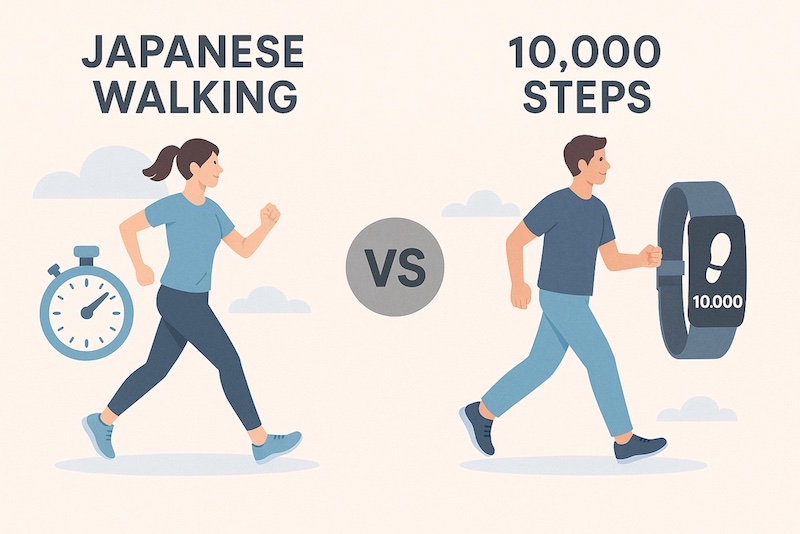
Japanese interval walking sounds almost suspiciously simple. Walk fast for three minutes, walk easy for three minutes, and repeat. That is basically it. No complicated equipment. No hard-to-follow choreography. Just a structured way to turn an ordinary walk into a real training session.
But the obvious question is fair: does the science actually support it? Short answer, yes, with some important nuance. The research behind Japanese walking, usually called interval walking training or IWT, is real. It was developed and studied by researchers at Shinshu University in Japan, and the best evidence shows meaningful benefits for aerobic fitness, blood pressure, leg strength, and some markers tied to metabolic health. If you want the basic method first, our complete guide to Japanese walking lays it out step by step.
The catch is that most of the best-known studies were done in middle-aged and older adults, not every population on earth. So the science is promising, but it should not be oversold like a miracle hack. Here is what the research actually says.
Where Japanese interval walking came from
Japanese interval walking was built around a very specific training idea: alternate brisk walking that feels fairly hard with slower recovery walking that lets you reset just enough to go again. In the original research model, the faster intervals were done at roughly 70% or more of peak aerobic capacity, while the easier intervals were done around 40% or less. The usual prescription was five rounds of 3 minutes fast and 3 minutes easy, for about 30 minutes total, at least four days per week.
That matters because this is not random speed walking. It is a structured interval program. The fast sections are supposed to feel clearly harder than your normal pace. According to the CDC’s intensity guide, moderate work usually means you can talk but not sing, while vigorous effort makes talking tough. Japanese walking usually lives somewhere in that moderate-to-vigorous zone during the brisk blocks, depending on your fitness level.
The history is useful here too. The method was developed by Professor Hiroshi Nose and Professor Shizue Masuki at Shinshu University as a practical way to deliver interval-style training through walking, not running. That decision is a big part of why the method has held attention for so long. Running intervals can be effective, sure, but they are also a rough sell for people who are older, deconditioned, heavier, or dealing with mild joint irritation. Walking intervals lower that barrier while still giving the body a reason to adapt.
That design also helps explain why the 3-minute format stuck. A one-minute burst can be too short for some people to settle into a strong pace, while a much longer hard interval can become discouraging fast. Three minutes is long enough to raise breathing and heart rate, but short enough that many beginners can still complete repeated rounds. The easier three-minute blocks stop the session from becoming one long grind and make it more realistic to repeat several times per week.
If you are still learning how that should feel in real life, read our guide on how fast you should walk during Japanese interval walking. Most people get better results by nailing the contrast between fast and easy, not by forcing a speed that falls apart after one or two intervals.
That point matters because the science was built around repeatable effort, not heroic effort. A lot of beginners make the fast intervals too fast on day one and then assume the whole method is not for them. The original idea is much steadier than that. You should feel challenged, warmer, and noticeably more breathy during the brisk blocks, but still in control. When people understand that, the method starts to feel less like a test and more like a training rhythm they can actually learn.
What the studies found
The strongest early data comes from Japanese trials in adults around their 60s, along with one smaller study in sedentary middle-aged adults. In that smaller 3-month trial, the interval walking group was asked to do at least five 3-minute easy and 3-minute brisk sets on four or more days per week. The people who completed the program improved peak aerobic capacity and lowered resting systolic blood pressure, while the non-training group did not show those gains. That is a big deal because better aerobic capacity usually means daily tasks feel easier, from climbing stairs to carrying groceries without getting excessively winded.
A larger follow-up analysis in hundreds of middle-aged and older adults found a similar pattern. After several months of interval walking, participants improved aerobic fitness and thigh strength, while body weight, body fat, blood pressure, and blood glucose moved in a healthier direction on average. The people with lower starting fitness tended to improve the most, which is honestly one of the most useful findings for regular readers. You do not need to begin as a fit person to benefit. In some ways, being less fit gives you more room to respond.
One reason that result matters is that it helps explain why Japanese walking is more than a step-count trick. The workout is trying to improve capacity, not just pile up minutes. When the brisk intervals are truly brisk for your body, your heart rate rises, your breathing deepens, and the working muscles need more oxygen. Repeat that stress often enough and the body tends to get better at delivering and using oxygen. That is one of the reasons researchers keep finding gains in VO2 peak or peak aerobic capacity, which is a fancy term for how much oxygen your body can use during hard effort.
Researchers at Shinshu University have also reported that the total amount of high-intensity walking time seems to matter more than the total amount of easy walking time. In plain English: the brisk segments are the engine of the method. The slow segments are still important, but mainly because they let you recover enough to keep the brisk work honest. If every interval turns into a casual stroll, the training effect drops. If every interval becomes too hard to repeat, consistency usually disappears.
There is also newer work suggesting interval walking may help bone health in some postmenopausal women, especially those starting with lower bone mineral density. That does not mean one walking plan cures osteoporosis. This suggests interval walking may have benefits beyond aerobic fitness in postmenopausal women, but that finding is still population-specific and should not be generalized too broadly yet.
If your main goal is body composition, do not skip the fine print. Exercise studies often show better fitness and cardiometabolic markers before they show dramatic fat-loss headlines. Our article on Japanese walking for weight loss and calorie burn explains why that difference matters.
The practical takeaway is pretty grounded. The science does not say every person will get the exact same blood pressure drop or fitness gain. It does say this format can create measurable change when people do it regularly enough and at a real training intensity. That is useful because a lot of people assume walking only counts if it is very long, very fast, or attached to a giant daily step target. The research on interval walking says quality matters too.
Why interval walking may work better than steady walking for some people
The basic idea is not mysterious. Intervals push your heart, lungs, blood vessels, and leg muscles to adapt to repeated changes in demand. A steady walk is still healthy, obviously, but it may not challenge aerobic capacity as much if the pace never climbs. Japanese interval walking gives you small, repeatable doses of harder work without asking you to run, jump, or do anything especially harsh on the joints.
That structure may also help adherence. A brisk three-minute block feels manageable because recovery is always coming. Shinshu University’s long-running program also reported about 70% adherence over 22 months in middle-aged and older adults, which is encouraging for a long-term walking intervention. A workout only works if people keep doing it. If you want a softer on-ramp before working up to full sessions, our 14-day beginner plan is a good place to start.
There is a practical angle too. Thirty minutes, four days per week, lines up pretty well with standard physical activity guidance. That makes Japanese walking easier to fit into real life than exercise plans that need a gym, a class booking, or a lot of extra setup.
For some people, steady walking feels easier to start but harder to progress. The walk stays comfortable, which is fine for general movement, yet it may stop feeling like training after a while. Intervals solve that by giving you a clear job during the brisk phase. You are not wondering whether today counts. You know when to push, when to recover, and when the session is done. That built-in structure is probably one reason interval walking can feel more purposeful without becoming intimidating.
It can also be more forgiving than all-out HIIT models. The fast blocks are challenging, but they are not meant to be sprints. For older adults especially, that matters. A brisk pace that raises breathing and heart rate can still improve fitness without asking the body to absorb the impact of repeated running or plyometric work. In other words, the method borrows the logic of interval training while keeping the movement pattern familiar.
That familiar movement pattern is not a small advantage. Exercise plans fail all the time because they ask people to learn too many new things at once. Japanese interval walking keeps the skill demand low. You already know how to walk. The only new job is to shift gears on purpose. For adults who feel intimidated by exercise culture, that simplicity can remove a lot of friction and make consistency more likely.
What the science does not prove
This is the part people tend to skip. Japanese interval walking is evidence-based, but the evidence is not unlimited. Much of the research comes from the same research group and focuses heavily on middle-aged and older Japanese adults. That does not invalidate the findings, but it does mean we should be careful about claiming the exact same results for younger adults, athletes, pregnant walkers, or people with complicated medical conditions.
It also does not prove that Japanese walking is automatically better than every other form of exercise. A 2021 review of HIIT in older adults suggests interval-based training is generally well tolerated and can be beneficial, but it also notes that protocols vary and more research is still needed. So the honest take is this: Japanese walking is a very credible option, not the one sacred cardio method that replaces everything else forever.
If you have uncontrolled blood pressure, heart disease, severe balance problems, or joint pain that flares with brisk walking, get medical guidance before jumping in. And if you are trying to figure out whether this style is enough for your bigger routine, our piece on whether Japanese walking is enough exercise can help you think through the bigger picture.
There is another limitation worth saying out loud: exercise studies often involve supervised testing, coaching, or clear intensity targets. Real life is messier. People guess their pace, skip recovery days, walk on steep routes one week and flat routes the next, or turn every brisk segment into the same medium speed. So if you try Japanese walking and do not feel much different after a week or two, that does not automatically mean the research was wrong. It may just mean the training dose has not become consistent enough yet.
That is also why safety and expectations matter. If you are older, very deconditioned, or managing hypertension, it makes sense to start with fewer rounds, slightly easier brisk intervals, or flatter routes. The point is not to prove toughness. The point is to accumulate repeatable bouts of walking that are hard enough to stimulate change and safe enough to continue next week.
So the limitation is not that the method lacks evidence. It is that readers need to interpret the evidence at the right scale. The studies support Japanese interval walking as a useful tool. They do not support turning every possible benefit into a certainty for every possible person. Keeping that distinction clear is part of being honest about what the science can and cannot do.
The bottom line
The science behind Japanese interval walking is better than a lot of viral fitness trends, frankly. Studies suggest that a simple 3-minute fast, 3-minute easy format done several times per week can improve aerobic fitness, lower blood pressure, strengthen the legs, and support broader metabolic health, especially in middle-aged and older adults. The mechanism makes sense, the protocol is practical, and the barrier to entry is low.
What it is not: instant magic, guaranteed weight loss, or proof that easy walking is useless. What it is: one of the more realistic, research-backed ways to make walking actually train your body instead of just filling time. For most people, that is plenty.
The best way to interpret the science is probably this: Japanese interval walking is not exciting because it is trendy. It is exciting because it gives ordinary people a realistic way to reach a higher training intensity through walking. For a lot of adults, especially people who are not going to run intervals or join a gym program, that is a meaningful gap to fill.
So if you want a sensible conclusion, here it is. The research supports Japanese interval walking as a legitimate exercise method with measurable benefits. The strongest evidence is still in middle-aged and older adults, and more research in other groups would help. But the core idea has held up well: alternating brisk and easy walking can do more for fitness and blood pressure than staying at one comfortable pace all the time.
If you want the original research background, Shinshu University’s overview of interval walking training and its health effects is a useful place to start.
For a reader trying to decide whether to do it, that is probably enough. You do not need perfect conditions, expensive gear, or athlete genetics to try the protocol. You need a safe place to walk, a way to time the intervals, and enough patience to let the routine work over months instead of a weekend. That is one reason the method keeps standing out. It asks for effort, but it asks in a way many people can live with.
That last part is worth emphasizing because it is where a lot of exercise advice falls apart. A program can look brilliant in theory and still be useless for ordinary adults if it is too technical, too painful, or too disruptive to everyday life. Japanese interval walking is not easy, exactly, but it is understandable. People can picture themselves doing it. And when a method feels doable, it has a better chance of surviving past the first wave of motivation.