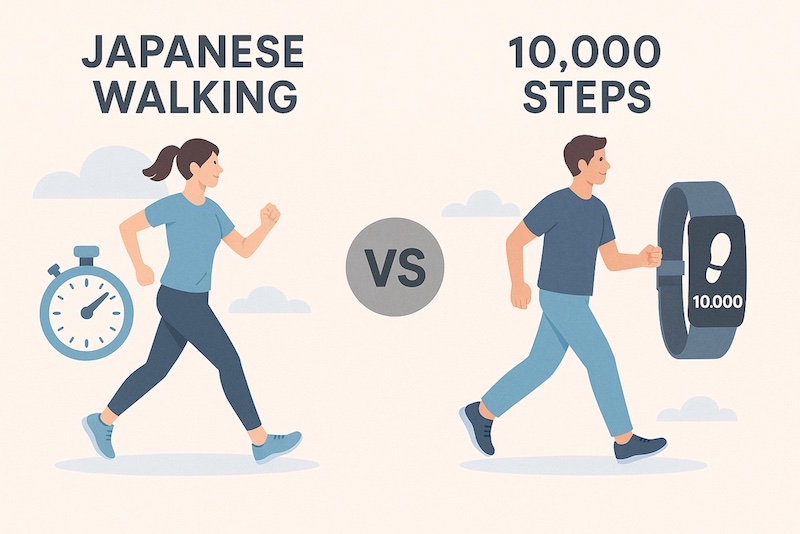
Yes, Japanese walking can be enough exercise for a lot of adults if you do it often enough and push the brisk intervals hard enough. But there is a catch, and it matters. If by “enough exercise” you mean all the exercise your body needs in a week, the answer is usually no. It can cover the aerobic side very well. It does not automatically cover strength work, and for older adults it does not fully cover balance work either.
That is why this question gets answered badly online. People turn it into a yes-or-no fight when the honest answer is more useful than that. Japanese interval walking can absolutely be a serious workout. It is not just a dressed-up stroll. But whether it is enough depends on how many weekly minutes you do, how brisk your fast segments really are, and what your bigger goal is: general health, weight loss, fitness, blood-pressure support, or replacing a more complete training plan.
If you are still new to the method, start with our complete guide to Japanese walking. It explains the usual 3-minutes-brisk, 3-minutes-easy structure before you worry about whether the plan is “enough.”
Short answer: yes for cardio, not always for a complete fitness plan
Public-health guidelines are pretty consistent here. Adults are generally advised to get at least 150 minutes of moderate-intensity aerobic activity per week, or 75 minutes of vigorous activity, or a mix of both, plus muscle-strengthening work on at least 2 days per week. Brisk walking counts as moderate aerobic exercise. So if your Japanese walking sessions add up to that weekly target, then yes, the routine can be enough to meet the aerobic recommendation.
Where people get tripped up is assuming that hitting the walking minutes means the whole exercise picture is finished. It usually is not. Walking, even interval walking, is still mostly solving the cardio problem. If you never challenge your upper body, trunk, and major leg muscles with strength work, you are leaving a pretty obvious gap.
Why Japanese walking can be more than “just walking”
Japanese walking matters because the intensity changes matter. In the original interval-walking research, participants alternated 3-minute easy intervals with 3-minute hard intervals, usually for 5 or more rounds, on 4 or more days each week. That structure was linked with larger gains in peak aerobic capacity and thigh muscle strength, plus a greater reduction in resting systolic blood pressure, than a more moderate continuous walking plan in middle-aged and older adults.
Later research on interval walking training found a pretty important detail: the amount of fast walking time was the key driver. In other words, the brisk minutes are doing a lot of the heavy lifting. If your “fast” intervals are barely faster than your recovery pace, the workout starts drifting toward ordinary walking, and the payoff gets fuzzier.
That is why Japanese walking can feel surprisingly effective in real life. It is still low impact, still accessible, and often feels more approachable than running for many people, but it asks a little more from your heart, lungs, and legs than a casual walk does. If you need help judging that effort, our guide on how fast to walk during Japanese interval walking can help you tighten up the brisk segments.
When Japanese walking probably is enough
Japanese walking can be enough exercise if your goal is general cardiovascular health and you are doing enough weekly volume. A simple example is someone doing 30-minute sessions 5 days per week, with genuinely brisk intervals and decent consistency. That person is likely covering the basic aerobic recommendation. For many adults, that is a strong foundation and a big upgrade from doing nothing.
It may also be enough for people who need a practical, repeatable habit more than a perfect training split. That matters more than fitness culture likes to admit. A realistic walking plan done month after month will beat a complicated gym routine that keeps dying after eight days. Japanese walking also makes sense for people who want a bit more intensity than regular walking without jumping straight to running or hard HIIT.
When Japanese walking is not enough by itself
Japanese walking is probably not enough by itself if your goal is a complete, well-rounded exercise plan. The biggest missing piece is strength training. Health guidelines still recommend working major muscle groups at least twice a week. Interval walking can help maintain leg function better than easy walking alone, but it is not the same thing as a structured strength routine for your whole body.
It is also not enough by itself if your goals are very specific. If you want major strength gains, more muscle, faster sprint performance, better bone-loading than walking can provide, or sport-specific conditioning, then walking alone is too narrow. Helpful, yes. Complete, not really.
For adults over 65, there is one more layer. Weekly activity guidance also includes balance-focused work, not just aerobic minutes and muscle work. Japanese walking helps you move more, and that is valuable, but it does not automatically replace direct balance practice. If that is your situation, our post on combining Japanese walking with strength training is a smart next step because it helps close the biggest gap without making your week feel ridiculous.
What about weight loss? Is it enough for that?
Sometimes. But not automatically. Japanese walking can help increase energy expenditure and overall activity, and the brisk intervals generally make it more demanding than a slow flat walk. Still, weight loss depends heavily on food intake, consistency, sleep, and total weekly movement, not one magic workout. So if by “enough” you mean “will this alone make fat disappear,” that answer gets shaky fast.
A better way to frame it is this: Japanese walking can be enough to become the main exercise habit in a weight-loss plan, but it usually works best alongside sensible eating and basic strength work. If body-composition change is your main priority, our guide to Japanese walking for weight loss and calorie burn gets more specific about what the sessions can and cannot do.
A practical way to tell if your routine is enough
Ask yourself four plain questions:
- Am I reaching roughly 150 minutes per week of real moderate effort, or the equivalent?
- Are my brisk intervals actually brisk enough to feel clearly harder than recovery walking?
- Am I doing any strength work during the week?
- If I am older or worried about falls, am I practicing balance in some direct way too?
If you answer yes to the first two but no to the last two, then Japanese walking is helping a lot, but your program is not fully rounded out yet. If you answer yes to all four, now you are talking about a more complete setup.
And if you are a beginner who feels overwhelmed by all this, do not overcomplicate it. Start with the walking habit first. Then layer in two short strength sessions later. Our beginner Japanese walking plan is a better place to start than trying to build the world’s most optimized schedule on day one.
The bottom line
Japanese walking can definitely be enough exercise to improve health, especially if it helps you consistently hit your weekly aerobic target with genuinely brisk intervals. For many adults, that alone is a huge win. But if you mean a complete exercise plan, the more honest answer is: almost, but not quite. Add strength work, and for older adults add some balance work too, and the routine gets much closer to complete.
If you want the public-health baseline, the CDC overview on adult physical activity recommendations is the clearest place to start. If you are 65 or older, the CDC page on physical activity for older adults explains why balance belongs in the conversation too.