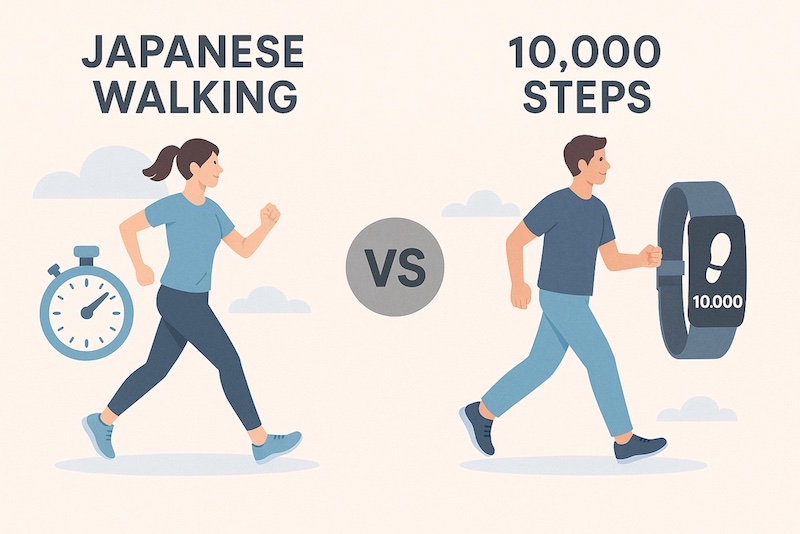
Bad weather, dark mornings, wildfire smoke, icy sidewalks, packed schedules. Real life gets in the way of outdoor walks all the time. The good news is that Japanese walking does not depend on fresh air, a scenic park, or some perfect walking trail. It depends on structure.
If you can alternate a genuinely brisk pace with an easy recovery pace for about 30 minutes, you can practice Japanese walking indoors just fine. That might mean a treadmill, a long hallway, a mall walking route, an indoor track, or even repeated laps through a large room. Not glamorous, maybe. Still practical.
Here is how to do indoor Japanese walking in a way that still feels legit, not like you are faking the workout.
Short Answer: Can You Do Japanese Walking Indoors?
Yes. You can do Japanese walking indoors as long as you keep the same core method: 3 minutes brisk, 3 minutes easy, repeated for about 30 minutes. The method is built around changing intensity, not around being outside.
That matters because the original interval-walking research focused on how hard people worked during the fast and easy segments. In those studies, the brisk intervals were done at a challenging effort and the recovery intervals were done at an easy effort. The surface can change. The training idea does not.
There is not much research that tests “indoor Japanese walking” as its own separate category. But we do have two useful anchors. First, interval walking studies in middle-aged and older adults found better fitness and lower blood pressure when people regularly alternated harder and easier walking over a period of months. Second, a 2022 systematic review found that treadmill and overground walking were largely comparable across many walking measures, even though some gait mechanics were not identical. That review focused on healthy young adults, so applying it to every indoor setup is still an inference. Even so, indoors looks like a reasonable substitute when you preserve the pacing contrast and use a setup that lets you move safely.
What Indoor Japanese Walking Should Feel Like
The easiest mistake indoors is making both speeds too similar. You are walking, but the intervals blur together. That defeats the point.
Use the talk test. During the brisk 3-minute block, aim for an effort where you can still talk but would not want to sing. During the easy 3-minute block, your breathing should settle enough that normal conversation feels comfortable again. That lines up with the CDC’s guidance on measuring exercise intensity without needing a heart-rate monitor.
- Fast interval: brisk, purposeful, and clearly harder than your normal pace, but still walking
- Easy interval: relaxed enough to recover, not just “slightly less fast”
- Total session: about 30 minutes of intervals, plus an easy 5 to 10 minute warm-up and an easy 5 to 10 minute cool-down
If you need a refresher on the basic rhythm, the complete guide to Japanese walking lays out the full 3-and-3 structure in plain English.
Best Indoor Places to Practice
Not every indoor space works equally well. You want a place where you can keep moving without constant stops, sharp turns, or having to dodge people every ten seconds.
- Treadmill: the cleanest option for many people because pace stays controlled and timing is easy
- Hallway laps: good if the hall is long enough and not crowded
- Mall walking route: surprisingly solid for recovery blocks and steady timing
- Large room or basement: works best for beginners who need convenience more than perfect flow
- Indoor track: ideal if you have access, because it feels closest to normal walking
If your space forces lots of tiny turns, keep your brisk pace a notch lower. Repeated quick pivots can irritate knees, hips, or ankles, especially when you are trying to move fast.
How to Do It on a Treadmill
The treadmill is usually the easiest indoor option because it removes guesswork. You can set one speed for fast blocks and another for easy blocks, then just follow the timer.
- Warm up for 5 to 10 minutes at an easy pace
- Set a brisk speed you can hold for 3 minutes without jogging
- Drop to a clearly easier speed for 3 minutes
- Repeat 5 rounds
- Cool down for 5 to 10 minutes
Most people do better when they chase effort, not a magical speed number. Your fast pace might be 3.8 mph. It might be 4.5 mph. It might be slower if you are deconditioned or coming back from time off. What matters is that the fast segment feels brisk enough to raise your breathing into a moderate-to-hard effort, while the easy segment lets you recover for the next round.
If you are new to the method, our beginner Japanese walking plan gives a gentler ramp-up so your first indoor sessions do not turn into a mess.
Some walkers like adding a slight incline during the brisk blocks instead of using big speed jumps. That can work well, especially if your treadmill feels awkward at faster speeds. Just keep the incline moderate enough that your form stays smooth.
How to Do It Without a Treadmill
No treadmill? No problem. The biggest adjustment is psychological. Indoors, especially in small spaces, brisk walking can feel a bit silly at first. Ignore that. You are there to train, not to win elegance points.
Pick a route that lets you walk continuously for at least 1 to 3 minutes before turning. Use a phone timer, smartwatch, or the free Japanese Interval Walking Timer so you do not keep checking the clock. During brisk blocks, shorten your stride slightly and quicken your cadence instead of overreaching with long steps. Indoors, that usually feels smoother and safer.
If the route is short, keep your chest up and slow down a touch before each turn. Fast, sloppy pivots are one of the easiest ways to make indoor walking feel awkward or tweaky.
Common Indoor Mistakes That Make the Workout Less Effective
- Using one medium pace the whole time. The workout works because of contrast.
- Holding the handrails on the treadmill. That usually changes your posture and makes the brisk pace less representative of normal walking.
- Skipping the warm-up. Indoor walking may feel controlled, but your calves and hips still need a few minutes to wake up.
- Choosing a cluttered route. Constant stopping kills rhythm.
- Making the fast pace too hard. If you are basically forced to jog, back off a little.
If you are unsure how often to repeat indoor sessions each week, the short version is consistency over heroics. Our guide on how often to do Japanese interval walking breaks that down in more detail.
Indoor Safety Tips That Actually Matter
Indoor walking removes weather problems, but it does not remove all safety issues.
- Wear real walking or training shoes, not socks on hard floors
- Use a flat, dry surface with enough clearance to swing your arms naturally
- On a treadmill, step onto the side rails before changing settings if you feel unstable
- If you have heart disease, balance problems, uncontrolled blood pressure, or major joint pain, talk with a clinician before pushing the brisk intervals
- Stop if you feel chest pain, severe dizziness, or unusual shortness of breath
That last point is not just boilerplate. Japanese walking is still exercise. Low impact does not mean zero stress.
Final Verdict: Indoor Japanese Walking Still Counts
If you cannot get outside, indoor Japanese walking is a practical version of the workout. The main job is to protect the fast-easy contrast, keep your route safe, and make the setup repeatable enough that you will actually do it again tomorrow or the next day.
That is the nice thing about this method. It does not need perfect conditions. It just needs a timer, a little honesty about effort, and a place to move. Outdoors is great. Indoors still works.