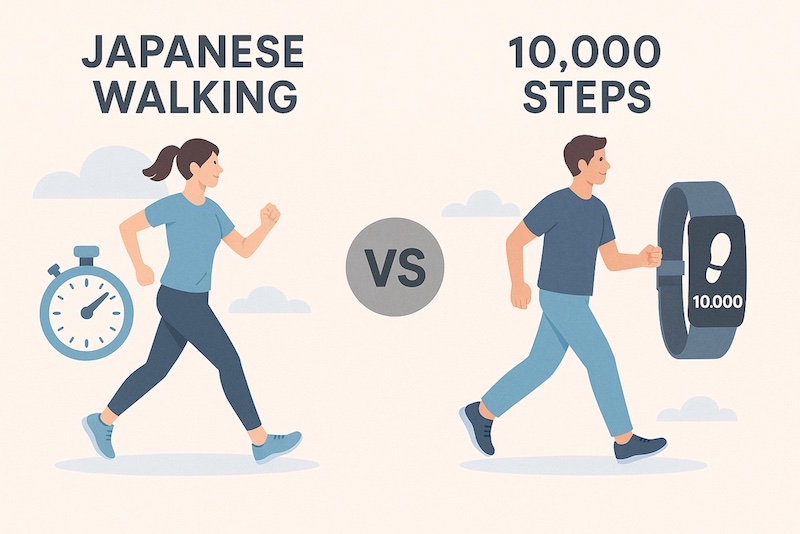
Japanese interval walking can be good for your mental health, but probably not in the exaggerated internet way. It is not a magic cure for anxiety, burnout, or depression. What it can do is give you a structured walking routine that is simple enough to repeat, brisk enough to feel like real exercise, and flexible enough to fit regular life.
That matters because mental-health benefits from exercise usually come from consistency more than one perfect workout. A growing body of research shows walking can reduce symptoms of depression and anxiety, while broader physical-activity guidance also links regular aerobic exercise with lower stress and better overall mental well-being. Japanese interval walking builds on that by turning an ordinary walk into a more focused session: 3 minutes brisk, 3 minutes easier, repeated for about 30 minutes.
If you are new to the method itself, start with our complete guide to Japanese walking. Once the rhythm makes sense, it gets much easier to use the workout for mood, stress relief, and head-clearing without overthinking it.
Short answer: the mental-health upside is real, but the strongest evidence is for walking in general
Here is the cleanest evidence-based answer. Walking itself has solid research behind it for mental health. A 2024 systematic review and meta-analysis of 75 randomized trials found that walking significantly reduced depressive and anxiety symptoms compared with inactive control groups. Public-health guidance from major institutions also notes that regular physical activity can lower stress, improve mental health, and reduce the risk of depression.
Japanese interval walking likely benefits from those same basic pathways because it is still walking. What we do not have yet is a large body of direct research proving Japanese interval walking is uniquely better than every other kind of walking for mood disorders. So the honest claim is this: Japanese walking is a practical, evidence-consistent way to get the mental-health benefits of walking, and its interval structure may make the habit easier to engage with for some people.
Why Japanese interval walking can feel mentally better than a random walk
A lot of people do not struggle with knowing that walking is “healthy.” They struggle with actually doing it often enough for it to matter. Japanese interval walking helps because it gives the session a job. You are not just wandering around hoping to feel calmer. You are alternating clear work and recovery blocks, which can make the walk feel more purposeful and less mentally noisy.
That brisk-easy rhythm can also pull your attention back into the body. During the harder segments, you notice breathing, posture, stride, and effort. During the easier segments, you feel the drop in tension. For some people, that alternating focus works almost like a moving reset button. Not in a mystical sense. More in a “my brain finally had something simple to do besides loop the same thoughts” sense.
It is also time-efficient. A 30-minute structured walk feels more doable than a vague promise to “be more active.” That matters for mental health because a routine you can complete even on a messy day tends to be more useful than an ideal plan you keep postponing.
Potential mental-health benefits you may notice first
The earliest benefits are usually pretty ordinary, which is actually a good sign. People often notice that they feel less wound up after a session, more mentally clear, and a little less stuck in stress loops. That fits with broader exercise guidance showing regular physical activity can help lower stress and support mental well-being.
Some people also sleep better when they walk consistently, especially if the workout helps them feel physically settled by the end of the day. That does not mean one Japanese walking session will fix insomnia. It means regular movement often improves the wider conditions that support better sleep, mood, and energy. If you are deciding when to place sessions, our article on morning vs. evening Japanese walking can help you match the workout to your own stress and sleep patterns.
There is also the confidence effect. Finishing a structured session gives you a small, repeatable win. That may sound minor, but when stress is high or mood is low, “I actually did the thing I planned to do” is not nothing. It is often the first crack in the all-or-nothing mindset that keeps exercise habits from sticking.
What the interval-walking research does and does not show
The research on interval walking training, the method behind Japanese walking, is strongest for physical outcomes such as aerobic fitness, blood pressure, muscle strength, and some metabolic markers. A 2024 review of interval walking training described it as effective for improving physical fitness and muscle strength while reducing several factors linked to lifestyle-related disease.
That physical side still matters for mental health. Feeling fitter, walking more confidently, and seeing progress can improve how exercise feels psychologically. A 2025 randomized trial in people with diabetes and lower-extremity weakness found interval walking improved gait speed and physical quality of life compared with continuous walking, even though it did not beat continuous walking on every outcome.
But this is where honesty matters: direct evidence for Japanese interval walking as a treatment for depression or anxiety is still limited. So if you have a diagnosed mental-health condition, think of Japanese walking as one useful support tool, not a replacement for therapy, medication, or clinical care when those are needed.
How to use Japanese walking for stress without turning it into another stressor
This part gets missed a lot. A workout that is supposed to help your head can backfire if you approach it like a punishment session. Japanese interval walking works best for mental health when the brisk intervals feel purposeful but still controlled. You should feel challenged, not wrung out.
- Keep the brisk blocks honest, not frantic. You want a clear effort jump, but you should still be walking, not panic-speed shuffling.
- Let the easy blocks actually be easy. Recovery is part of the method, not a sign you are slacking.
- Use a predictable route. Familiar paths lower friction and make it easier to start when your motivation is thin.
- Stop chasing perfection. A shorter session still counts if it helps you stay consistent.
If the pace question keeps tripping you up, our article on the science behind Japanese interval walking gives the research context, and our practical pacing articles can help you find a brisk effort that feels challenging without becoming miserable.
Who should be more careful with the mental-health framing?
If you are dealing with major depression, panic symptoms, severe anxiety, trauma-related symptoms, or exercise that reliably feels overwhelming, it is worth being more careful. Walking can still help, but the right version may be gentler, shorter, supervised, or paired with formal treatment. For some people, the structured intervals feel empowering. For others, they can feel like pressure. Pay attention to which camp you are in.
Older adults or anyone managing pain, mobility limitations, or medical conditions may also do better with modifications rather than the textbook 3-minute brisk blocks right away. If that sounds like you, our guide to Japanese interval walking for seniors is a better starting point than trying to force the full routine on day one.
And if your mood symptoms are persistent, worsening, or tied to safety concerns, get professional help. Exercise can be part of a mental-health plan. It should not be the only plan when the situation is more serious than everyday stress.
A simple mental-health-friendly Japanese walking session
If your goal is to feel better mentally, not to crush a workout, keep the setup boring and repeatable:
- 5 minutes easy warm-up
- 4 to 5 rounds of 3 minutes brisk and 3 minutes easy
- 3 to 5 minutes easy cool-down
During the brisk parts, aim for a pace that clearly raises effort but still feels under control. During the easy parts, let your breathing settle. Eat enough beforehand if low energy makes you feel edgy or lightheaded; our guide on what to eat before and after Japanese walking can help with that piece.
For broader context on walking and mood, this 2024 walking meta-analysis is worth a look. If you want a plain-language clinical reminder that movement and mental health are connected, the National Institute of Mental Health includes regular exercise and even 30 minutes of walking as part of basic mental-health self-care.
Bottom line
The mental-health benefits of Japanese interval walking are probably best understood as the benefits of walking plus the benefits of structure. The method gives you a repeatable rhythm, a little intensity, and a built-in sense of progress. That can help with stress, mood, and mental clarity, especially when the real win is simply getting yourself moving regularly.
Just keep the claims realistic. Japanese walking is a strong option for people who want exercise that feels more engaging than a casual stroll, but it is not a substitute for proper mental-health treatment when symptoms are serious. Used honestly, though, it can be a very solid tool.