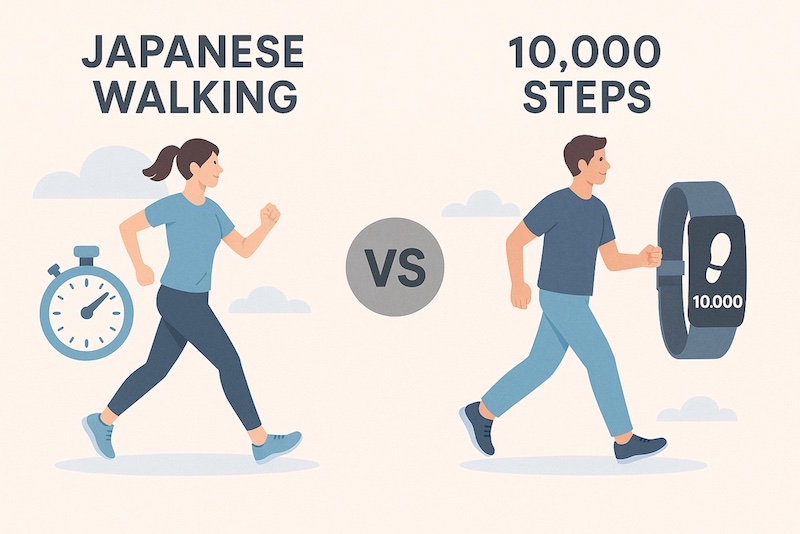
If you are paying for a gym mostly to walk on the treadmill, use a bike for warm-ups, or squeeze in cardio a few times a week, Japanese walking can absolutely cover a lot of that ground. The method is simple: walk briskly for three minutes, walk easy for three minutes, and repeat. Done consistently, it can become a real training session rather than just a casual stroll.
But if by “replace my gym membership” you mean “give me every major benefit I get from a full gym routine,” the honest answer is usually no. Japanese walking can do a lot for aerobic fitness and general health. It does not fully replace resistance training for all major muscle groups, and it does not magically cover every reason someone might use a gym.
The practical answer sits in the middle. For many adults, Japanese walking can replace the cardio portion of a gym routine and make a paid membership optional. For people who rely on the gym for strength training, heavier resistance, or equipment they genuinely use, it is better seen as one strong piece of the program, not the whole thing. If you need the basics first, start with our complete guide to Japanese walking.
Short Answer: Can Japanese Walking Replace the Gym?
Sometimes, yes. Completely, not always.
Japanese walking can replace a gym membership if your main goal is structured cardio, calorie burn, and a routine you can do almost anywhere. Research on interval walking training suggests this style of walking can improve aerobic fitness, leg function, and some cardiometabolic markers, especially in middle-aged and older adults. It also lines up pretty well with the idea that exercise needs to be realistic enough to repeat, not just effective on paper.
Where it falls short is the same place most walking routines fall short: strength. Public-health guidance for adults does not stop at aerobic activity. The CDC’s adult activity guidance recommends both regular aerobic work and muscle-strengthening activity on two or more days per week. So if quitting the gym also means dropping every meaningful form of resistance training, Japanese walking alone usually is not a full replacement.
What Japanese Walking Can Replace Really Well
This is the part where the method looks pretty strong. Japanese walking is one of the more practical ways to turn a normal walk into a challenging cardio session without joining a class, learning complex programming, or spending half your workout waiting for a machine. The brisk intervals raise effort. The easy intervals let you recover just enough to repeat that effort several times. That is a useful setup for people who want their workouts to feel purposeful but still low impact.
If your gym visits mostly look like 25 to 40 minutes on the treadmill, elliptical, or stationary bike, Japanese walking can cover that role surprisingly well. It gives you a defined workout structure, a clear sense of when to push, and a moderate-to-hard effort that can improve conditioning over time. The research base is strongest in older and middle-aged adults, not every population on earth, but it is solid enough to treat Japanese walking as legitimate exercise rather than a gimmick. Our article on the science behind Japanese interval walking goes deeper on that evidence.
It can also replace some of the convenience argument for the gym. A lot of people keep paying for access to a treadmill because weather, darkness, and schedule chaos make outdoor routines harder to maintain. Fair. But Japanese walking still works indoors, including on a treadmill, which means you may be able to keep the method without keeping the membership. If that is your situation, this guide on doing Japanese walking on a treadmill is the practical version.
For weight management, Japanese walking can also cover a useful lane. It will not erase the role of diet, obviously, but it can create a repeatable weekly calorie-burning habit while being easier on the joints than running for many adults. If fat loss is part of why you use the gym now, our piece on Japanese walking for weight loss and calorie burn explains what that can and cannot do in real life.
What It Usually Cannot Replace on Its Own
The big missing piece is resistance training. Walking works the lower body and can help leg function, sure, but it does not train all major muscle groups the way a well-designed strength routine can. That matters for muscle mass, strength, joint support, and long-term function. The Mayo Clinic’s strength training overview makes the point pretty clearly: strength work helps preserve muscle and bone health, supports balance and daily function, and is meant to be part of a complete fitness program, not an optional extra for bodybuilders.
So if your gym time includes barbell lifts, heavier dumbbell work, resistance machines, or structured upper-body and core training, Japanese walking is not a full replacement for that. It is a replacement for the cardio slice, not the entire pie. This matters even more as people age, because hanging on to strength and function becomes a bigger deal, not a smaller one.
It also may not replace the gym if the gym is what keeps you consistent. Some people really do better when the workout happens in a separate place with equipment ready, weather removed, and fewer excuses floating around. Others do better when they can step outside the front door and start walking in five minutes. Be honest about which type you are. The “best” plan on paper loses badly to the one you will actually do four days next week.
Who Can Probably Cancel the Membership
You are a good candidate for replacing the gym with Japanese walking if most of the following are true:
- your gym use is mostly cardio, not serious resistance training
- you have a safe outdoor route or a treadmill you can use without a gym membership
- you are willing to walk briskly enough for the hard intervals to feel meaningfully harder than the easy ones
- you can add simple strength work at home two days per week if needed
- you want a lower-cost, lower-friction routine that still feels like training
For this group, Japanese walking is often enough to make the monthly fee feel unnecessary. A pair of decent shoes, a timer, and a little consistency can cover a surprising amount of what a lot of casual gym-goers actually use the gym for.
Who Should Keep Some Form of Gym or Strength Setup
You probably should not treat Japanese walking as a total replacement if you want to build or maintain higher levels of strength, rely on heavier resistance to manage body composition, need supervised equipment, or simply enjoy lifting enough that it keeps you engaged. In that case, the smarter move is usually not choosing one or the other. It is using Japanese walking as your cardio base and keeping a leaner strength routine alongside it.
That hybrid setup can be pretty simple: three or four Japanese walking sessions per week, plus two short full-body strength sessions at home or at the gym. If you are older, deconditioned, or managing joint issues, scale the brisk intervals honestly and let strength work stay modest at first. The goal is not to prove toughness. It is to build a week you can repeat.
For some readers, especially older adults or people returning after a long break, the gym question is really a safety and support question. If that is you, the answer may be “not yet” rather than “never.” The pacing and modification ideas in Japanese Interval Walking for Seniors: Safe Modifications and Benefits can help you bridge that gap without pretending every body starts from the same place.
A Better Question Than “Gym or Japanese Walking?”
A better question is: what job is the gym currently doing for you?
If the job is cardio, Japanese walking may do it well enough to replace the membership. If the job is full-body strength, progressive resistance, and access to equipment you genuinely use, then no, Japanese walking is not the whole answer. And if the job is motivation, structure, or a weather-proof place to move, the answer depends more on your habits than on exercise science.
That is the real bottom line. Japanese walking can replace a lot of casual gym use, especially the treadmill-and-elliptical kind. It can improve fitness, support heart health, and give you a simple routine that does not need much setup. But it does not automatically replace strength training, and it does not magically make every other exercise tool irrelevant.
So can Japanese walking replace your gym membership? For plenty of people, yes, at least enough to justify canceling. For others, it is better used as the cardio backbone of a broader plan. The smart choice is not the one that sounds cleaner. It is the one that covers your real goals and keeps you moving month after month.