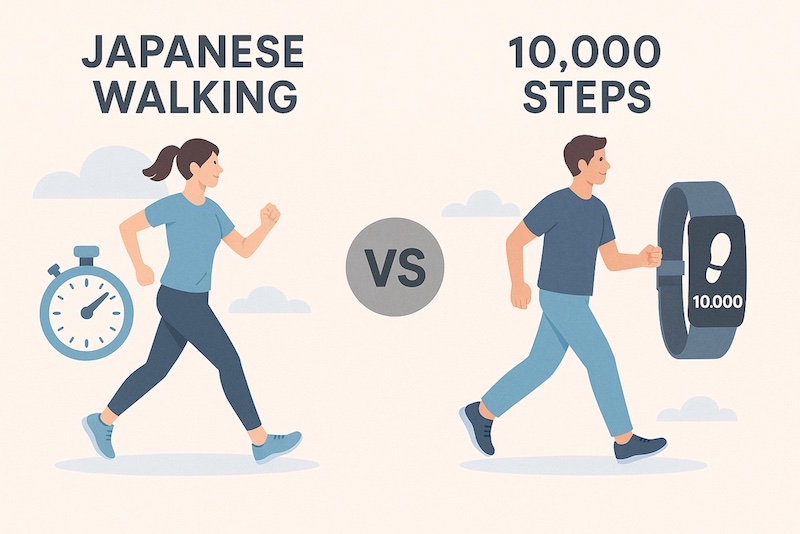
If you want to get fitter, someone will eventually tell you to start jogging. It’s simple advice. Jogging burns calories, improves endurance, and has decades of research behind it. But recently, Japanese Interval Walking has been gaining attention as a lower-impact alternative that still improves cardiovascular fitness.
So which one actually makes more sense?
Is Japanese walking better than jogging for weight loss?
Does jogging burn more calories?
And what about your knees over the long run?
Let’s break this down carefully, using research and physiology—not trends.
Contents
- What Is Japanese Walking (Interval Walking Training)?
- What Is Jogging (Steady-State Running)?
- Japanese Walking vs Jogging: Which Burns More Calories?
- Japanese Walking vs Jogging for Weight Loss
- Japanese Walking vs Jogging for VO2 Max and Heart Health
- Is Japanese Walking Better Than Jogging for Your Knees and Joints?
- Japanese Walking vs Jogging for Longevity
- Which Should You Choose?
- Final Verdict: Japanese Walking vs Jogging
What Is Japanese Walking (Interval Walking Training)?
Japanese Walking, often called Interval Walking Training (IWT), typically follows a simple format:
- 3 minutes brisk walking
- 3 minutes easy walking
- Repeat for 30 minutes
The brisk phase is usually performed at moderate-to-vigorous intensity. In practical terms, you can speak short phrases but not full sentences. The easy phase allows breathing and heart rate to recover.
This protocol was studied extensively by researchers in Japan, particularly in middle-aged and older adults. Improvements were observed in aerobic capacity, leg strength, and blood pressure after several months of consistent training.
In a randomized study of interval walking training, middle-aged and older adults experienced increases in aerobic capacity and muscle strength, as well as reductions in systolic blood pressure, compared with those doing moderate-intensity continuous walking.
It’s not casual strolling. It’s structured walking with purpose.
What Is Jogging (Steady-State Running)?
Jogging is continuous running at a moderate pace. It is typically performed at 4.5–6 mph and maintained for 20–45 minutes or longer.
Unlike interval walking, jogging keeps heart rate elevated without alternating recovery phases. It’s classified as steady-state aerobic exercise.
Jogging improves cardiovascular endurance, increases mitochondrial density, and strengthens the heart muscle over time. It has also been associated with reduced cardiovascular disease risk in long-term observational studies.
The main difference is intensity distribution: jogging is continuous, while Japanese walking alternates effort.
Japanese Walking vs Jogging: Which Burns More Calories?
From a pure calorie perspective, jogging wins.
According to the Compendium of Physical Activities:
- Jogging at 5 mph equals about 8–10 METs.
- Brisk walking at 4 mph equals about 5 METs.
For a 155–185 lb person, that translates roughly to:
- Jogging: 9–12 calories per minute
- Brisk walking: 4–7 calories per minute
Over 30 minutes, jogging may burn 270–360 calories. Interval walking might burn 150–240 calories depending on pace and body weight.
But here’s the part people miss.
Calorie burn per session is only one variable. Total weekly energy expenditure matters more. Many people jog twice a week but skip sessions due to soreness or joint discomfort. Japanese walking is often easier to perform 4–5 days per week.
Adherence changes the math.
Additionally, interval-style exercise can increase post-exercise oxygen consumption slightly more than steady-state activity. The EPOC effect is modest, but it contributes to overall energy expenditure.
If you’re looking strictly at “calories per minute,” jogging is higher. If you’re looking at “calories per month,” consistency may narrow the gap.
Japanese Walking vs Jogging for Weight Loss
Weight loss depends on energy balance, but also on sustainability.
Jogging creates a larger calorie deficit per workout. However, vigorous steady-state cardio can increase hunger in some individuals, which may offset the deficit if not managed carefully.
Interval walking still elevates heart rate into the moderate-to-vigorous range. Studies on interval walking training in Japanese adults showed improvements in body composition markers when performed regularly.
Another factor is recovery. When exercise leaves you overly fatigued, total daily movement often decreases. Lower-impact training may preserve overall activity levels.
For beginners, overweight individuals, or those returning after time off, Japanese walking often provides a safer and more repeatable fat-loss strategy.
Jogging works. But the best fat-loss exercise is the one you can maintain for months without injury.
Japanese Walking vs Jogging for VO2 Max and Heart Health
VO2 max measures your body’s ability to take in, transport, and use oxygen during exercise. It’s usually expressed in milliliters of oxygen per kilogram of body weight per minute (ml/kg/min). The higher it is, the more efficiently your heart, lungs, and muscles work together.
It’s also one of the strongest predictors of cardiovascular health and long-term mortality. In plain terms, a higher VO2 max is strongly associated with lower risk of heart disease and all-cause death.
Jogging has long been known to improve VO2 max. When you jog consistently, several things happen inside your body.
Stroke volume increases, meaning your heart pumps more blood with each beat. Over time, the left ventricle becomes more efficient at filling and ejecting blood. Resting heart rate often drops as a result.
At the muscular level, mitochondrial density increases. Mitochondria are the “energy factories” inside muscle cells. More mitochondria means better oxygen use and improved endurance capacity.
That’s steady-state endurance training at work.
But here’s where Japanese interval walking becomes interesting.
Interval walking training (IWT), particularly the 3-minute fast / 3-minute slow format studied in Japan, has been shown to significantly increase VO2 peak in middle-aged and older adults. In the well-known Nemoto et al. 2007 study published in Mayo Clinic Proceedings, participants who performed interval walking several times per week improved aerobic capacity more than those who performed continuous moderate-intensity walking.
That comparison is important.
It wasn’t interval walking versus jogging. It was interval walking versus steady moderate walking. And the interval group improved more.
Why would that happen?
Because intervals push you closer to your ventilatory threshold. That’s the intensity level where breathing becomes noticeably harder and speaking full sentences is difficult. Physiologically, this is near the point where lactate begins to accumulate faster.
When you repeatedly approach that threshold, even through brisk walking, the cardiovascular system is challenged in a more dynamic way. Heart rate rises during the fast phase, partially recovers during the slow phase, then rises again.
That repeated rise-and-recover pattern appears to stimulate adaptation efficiently.
It’s not just about working hard. It’s about alternating stress and recovery.
Jogging, especially at a moderate pace, may sit slightly below that threshold for many recreational exercisers. It builds endurance steadily, but it does not create the same oscillating cardiovascular demand unless pace is pushed.
That doesn’t make jogging inferior. It just means the stimulus is different.
Another factor is adherence. Middle-aged and older adults may not tolerate running volume well due to joint discomfort. If jogging frequency drops because of soreness, total cardiovascular stimulus decreases.
Interval walking allows individuals to reach moderate-to-vigorous intensity without impact forces associated with running. Ground reaction forces during walking are substantially lower than during jogging, yet heart rate can still be elevated into effective training zones.
In practical terms, Japanese walking can push heart rate into roughly 70–85% of maximum during brisk intervals, depending on fitness level. That range is commonly associated with improvements in aerobic capacity.
And because recovery intervals are built in, sessions often feel more manageable psychologically. People finish feeling worked—but not wrecked.
There’s also evidence that interval-based aerobic training improves endothelial function, which relates to how well blood vessels dilate. Healthy endothelial function supports blood pressure regulation and overall vascular health.
The Nemoto study also reported reductions in systolic blood pressure in the interval walking group. That’s meaningful for long-term heart health.
So how do they compare directly?
Jogging:
- Strongly improves VO2 max with sufficient duration and intensity
- Builds steady aerobic endurance
- Efficient for trained individuals
Japanese interval walking:
- Improves VO2 max significantly compared to steady walking
- Reaches ventilatory threshold without running
- Produces cardiovascular stimulus with lower orthopedic stress
If someone is already comfortable jogging and free of injury, jogging remains an excellent cardiovascular tool.
But if someone is deconditioned, over 50, overweight, or managing joint discomfort, Japanese interval walking provides a scientifically supported way to improve aerobic capacity without running.
And for heart health, the key isn’t whether your feet leave the ground.
It’s whether your heart is challenged often enough to adapt.
Is Japanese Walking Better Than Jogging for Your Knees and Joints?
This is where the biggest practical difference shows up, especially for adults over 40.
Jogging produces ground reaction forces roughly 2 to 3 times body weight with each stride. That force travels up through the ankle, knee, and hip thousands of times in a single session. A 30-minute jog can easily involve 3,000–5,000 foot strikes per leg.
Over time, that repeated loading has to be tolerated by cartilage, tendons, and connective tissue.
Walking, even brisk walking, produces significantly lower impact forces. Typical ground reaction forces during walking are closer to 1 to 1.5 times body weight. The loading rate is also slower, meaning the force is absorbed more gradually.
That difference in magnitude and loading rate matters.
Now, it’s important to be precise here. Jogging is not automatically “bad for your knees.” In fact, several observational studies suggest that recreational running does not increase the risk of knee osteoarthritis in healthy individuals. Some data even show lower arthritis rates in recreational runners compared to sedentary people.
But injury risk and arthritis risk are not the same thing.
Annual injury rates among recreational runners have been estimated between 20% and 50%, depending on study design and what qualifies as an injury. The most common issues include:
- Patellofemoral pain syndrome (front-of-knee pain)
- Medial tibial stress syndrome (shin splints)
- Achilles tendinopathy
- Plantar fasciitis
- IT band irritation
These are typically overuse injuries. They happen when tissue capacity is exceeded before adaptation catches up.
Walking, on the other hand, has a significantly lower reported injury rate. Because impact forces are lower and stride length is shorter, cumulative stress per session is reduced.
Japanese interval walking adds intensity without adding impact.
During the brisk phase, heart rate climbs. Muscles work harder. But the foot never leaves the ground. There’s no flight phase like in running. That alone reduces mechanical load considerably.
For someone who weighs 220 pounds, that difference in force is magnified. Two to three times body weight per step becomes 440–660 pounds of force with every landing. Multiply that by thousands of strides and you begin to understand why beginners sometimes develop knee or shin pain quickly.
Interval walking allows cardiovascular stress to rise while orthopedic stress remains controlled.
Age also changes the equation.
As we move into our 40s and 50s, tendon stiffness, cartilage resilience, and recovery capacity gradually shift. That doesn’t mean running must stop. But it does mean tissue tolerance may not match what it was at 25.
Lower-impact training becomes more attractive because it supports consistency.
Another factor is recovery time. After a hard jogging session, especially on pavement, soreness in calves or knees can last 24–72 hours. When soreness lingers, the next session is often delayed.
With interval walking, many people report feeling worked but not beat up. The fast intervals challenge the cardiovascular system, but connective tissue strain remains moderate.
That makes it easier to train again the next day if desired.
Surface also matters. Jogging on concrete increases loading compared to softer surfaces like trails or tracks. Walking, even on harder surfaces, still produces lower forces than running.
Stride mechanics play a role too. Joggers who overstride—landing with the foot far ahead of the body—often increase braking forces and joint stress. Walking naturally limits overstriding because one foot remains in contact with the ground.
All of this adds up to a simple reality.
If your knees, shins, or Achilles tendons have given you trouble before, Japanese interval walking may provide a safer cardiovascular option. It allows you to reach moderate-to-vigorous intensity without the repetitive impact of running.
And consistency is deeply tied to joint comfort.
An exercise plan that repeatedly causes pain interruptions rarely lasts. An exercise plan that feels sustainable is more likely to be repeated week after week.
That’s not about choosing the “easier” option. It’s about choosing the option your body can tolerate long term.
For some people, jogging is perfectly fine. For others, especially those returning to exercise, carrying extra weight, or managing old injuries, interval walking may simply be the smarter path forward.
Joint health doesn’t just affect today’s workout.
It determines whether you’re still moving ten years from now.
Japanese Walking vs Jogging for Longevity
When we zoom out and look at long-term health instead of short-term fitness gains, the conversation changes. Large population studies consistently show that both brisk walking and running are associated with lower all-cause mortality and lower cardiovascular mortality. In other words, people who move regularly at moderate-to-vigorous intensity tend to live longer than those who remain sedentary.
Some research has shown that even small amounts of running—sometimes as little as 5 to 10 minutes per day at a slow pace—are associated with reduced risk of death from cardiovascular causes. That’s significant because it suggests intensity matters, but extreme volume is not required. On the other side, brisk walking performed consistently has also been linked to meaningful reductions in heart disease risk, stroke risk, and overall mortality.
What appears to matter most is not whether you run or walk, but whether you regularly reach moderate-to-vigorous intensity. This intensity range is typically defined as 3 to 6 METs for moderate activity and above 6 METs for vigorous activity. It is at these levels that heart rate rises, breathing deepens, and cardiovascular adaptation is stimulated.
Jogging naturally pushes most people into the moderate-to-vigorous range and keeps them there for the duration of the session. Continuous aerobic work improves endothelial function, lowers resting heart rate, and can reduce blood pressure over time. These adaptations contribute to long-term heart health and reduced cardiovascular disease risk.
Japanese interval walking reaches that same intensity threshold in a different way. During the brisk three-minute segments, heart rate rises into moderate or even vigorous territory depending on pace and fitness level. The slower recovery phases allow partial recovery, but the repeated elevation of heart rate ensures that cardiovascular stress is applied consistently.
This pattern may actually help some people accumulate more total time in effective heart rate zones across the week. Because interval walking is lower impact, sessions can often be performed more frequently without joint discomfort. Greater weekly consistency can translate into stronger long-term cardiovascular adaptations.
There is also the behavioral component of longevity. An exercise program that causes recurring injury or burnout is unlikely to be sustained over decades. Walking intervals, because they reduce orthopedic strain, may support adherence in middle-aged and older adults who might otherwise avoid higher-impact exercise.
From a lifespan perspective, both jogging and Japanese interval walking are beneficial tools. The real question becomes which one you can continue performing safely for five, ten, or twenty years. Long-term health is less about intensity in one season of life and more about repeatable habits across many seasons.
If jogging feels good and remains pain-free, it offers clear cardiovascular benefits. If interval walking allows you to train consistently without joint flare-ups, it may provide similar longevity advantages with lower risk of interruption. The heart responds to challenge, but it also benefits from consistency.
In the end, longevity favors sustainability. The exercise you will still be doing next decade is the one most likely to support a longer, healthier life.
Which Should You Choose?
Choose Japanese walking if:
- You’re new to exercise
- You have joint discomfort
- You’re returning after time off
- You prefer structured intervals
- You want lower injury risk
Choose jogging if:
- You enjoy running
- You’re training for endurance events
- Your joints tolerate impact well
- You want higher calorie burn per minute
You can also combine them. Many people use interval walking on recovery days and jog once or twice per week.
It doesn’t have to be a rivalry.
Final Verdict: Japanese Walking vs Jogging
Jogging burns more calories per minute and builds endurance efficiently.
Japanese walking delivers strong cardiovascular benefits with lower joint stress and often better long-term adherence.
For many adults—especially those over 40—Japanese interval walking may be the smarter starting point. It builds aerobic capacity, improves leg strength, and reduces impact stress.
Fitness compounds when it’s repeatable.
If jogging keeps you consistent and pain-free, stick with it.
If walking intervals keep you consistent and pain-free, that may be the better choice. Luckily, we have a free Japanese Interval Walking timer to help you out!
The best exercise is not the hardest one.
It’s the one you’ll still be doing next year.