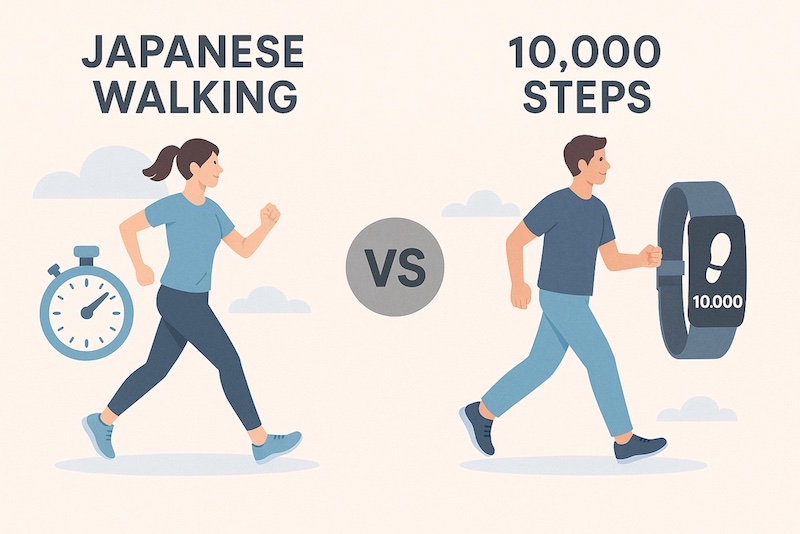
A lot of people like Japanese interval walking because the method is simple. Three minutes brisk, three minutes easy, repeat for about 30 minutes. The confusing part comes right after that: how do you turn one workout into an actual plan you can follow for a month, two months, or longer?
The short answer is that a good Japanese walking plan should get a little more demanding over time without getting reckless. The original interval-walking research was built around repeatable sessions done several days per week, not random all-out efforts. If you need the full foundation first, start with our complete guide to Japanese walking. Then use the plans below to match the method to your current fitness instead of guessing every week.
These programs are built around the same basic idea: keep the fast intervals clearly brisk, keep the easy intervals genuinely easier, and add workload slowly enough that you can still come back for the next session. That fits both the research behind interval walking and broader public-health advice. The CDC’s adult activity guidance says most adults should aim for at least 150 minutes of moderate-intensity activity per week plus muscle-strengthening work on two days a week. Japanese walking can cover a lot of that aerobic work, but only if the plan stays consistent.
Before You Pick a Plan, Know What Counts as a Real Japanese Walking Session
A real session is not just “walk kinda faster sometimes.” The brisk blocks should feel purposeful. You should be breathing harder and probably only able to speak in short phrases, not have a relaxed full conversation. The easy blocks should let you recover enough to hit the next brisk round with control. If that effort contrast is fuzzy, clean that up first. Our guide on how fast you should walk during Japanese interval walking can help you dial it in without overcomplicating the pace.
This matters more than people think. Later interval-walking research suggests that higher-intensity walking time is an important driver of improvement, which is one reason it usually makes sense to protect the quality of the brisk segments before you pile on extra volume. Better contrast often beats more fluff.
4-Week Japanese Walking Plan: Build the Habit First
This first plan is for beginners, inconsistent exercisers, or anybody coming back after a layoff. The goal is not to crush four weeks. The goal is to finish four weeks with a routine that feels doable enough to keep going.
- Week 1: Do 3 sessions. Aim for 4 rounds of 3 minutes brisk and 3 minutes easy. That is 24 minutes of intervals, plus a short warm-up and cool-down.
- Week 2: Do 3 sessions again. Move up to 5 rounds in one or two sessions if week 1 felt controlled.
- Week 3: Do 4 sessions. Keep most sessions at 5 rounds, but allow one shorter day if your legs feel heavy.
- Week 4: Do 4 sessions. Hold 5 rounds in each session and focus on making the brisk segments more honest rather than adding extra time.
This is a good “earn the basics” month. By the end of it, the session should feel more organized and less awkward. If you are still unsure about weekly frequency, our article on how often to do Japanese interval walking explains why four weekly sessions are a useful target in many interval-walking programs without pretending everybody has to start there immediately.
If even this version feels too aggressive, that is not some moral failure. It just means you need a softer runway. In that case, our 14-day beginner plan is the better entry point before you try to force the full structure.
8-Week Japanese Walking Plan: Turn the Routine Into Real Training
Once the method feels familiar, the next phase is about making the workload more repeatable and slightly more demanding. This is usually the sweet spot for readers who already know the rhythm and want better stamina, better pace control, or more obvious fitness progress.
- Weeks 1 to 2: Do 4 sessions per week at 5 rounds each. Keep the structure stable and sharpen the brisk intervals.
- Weeks 3 to 4: Add a sixth round to 1 session per week. The other 3 sessions stay at 5 rounds.
- Weeks 5 to 6: Keep 4 sessions per week. Now do 2 sessions with 6 rounds and 2 sessions with 5 rounds.
- Weeks 7 to 8: Either hold that pattern or make one of the 6-round sessions slightly hillier if your joints tolerate it well.
That progression may look almost boring on paper. Good. Boring is useful here. The WHO’s physical activity guidance emphasizes that any activity is better than none and that people should build up activity in a sustainable way. A solid 8-week plan should feel like a steady climb, not a dare.
If the classic 5-round workout no longer feels very challenging, this is also the phase where route choice starts to matter. A mild incline, a flatter path that lets you hold rhythm, or one extra round can all work. Just do not change everything at once. If you want ideas for what comes after the standard setup, our guide on progressing beyond the basic Japanese walking routine is the natural next read.
12-Week Japanese Walking Plan: Build a Long-Term Weekly System
The 12-week version works best for people who want more structure, not necessarily more suffering. Think of it as a full season of training. You are not trying to prove toughness. You are trying to get fitter while staying healthy enough to keep showing up.
- Weeks 1 to 4: Do 4 sessions per week. Most sessions are 5 rounds. One session can reach 6 rounds if recovery is good.
- Weeks 5 to 8: Keep 4 sessions per week. Build to 2 sessions with 6 rounds, 1 standard 5-round session, and 1 easier recovery session with 4 to 5 rounds.
- Weeks 9 to 10: Hold the same weekly frequency, but make the brisk intervals cleaner and more deliberate instead of automatically adding time.
- Weeks 11 to 12: Choose one focus: either a longer session with 6 rounds, a slightly hillier session, or better pace quality across all 5-round workouts. Pick one lever only.
For many adults, this is enough structure to carry Japanese walking from “interesting workout” into “part of my normal week.” It also leaves room for strength work, mobility, or easier walks on other days. If you try to max out every interval session for 12 straight weeks, the plan usually gets dumb pretty fast.
How to Tell Whether the Plan Is Working
The first signs of progress are often subtle. Your brisk pace feels less chaotic. Recovery inside the easy blocks gets smoother. One extra round does not feel like a personal insult anymore. You may also notice daily-life carryover, like stairs feeling less rude or longer walks feeling more manageable. Those are useful wins, even if the scale is being dramatic.
On the other hand, a plan probably needs to be scaled back if your fast and slow intervals blur together, your pace falls apart by the third round, small aches keep hanging around, or you start dodging sessions because the workout suddenly feels miserable. The whole point is repeatable training stress. Once the structure becomes too hard to recover from, it stops doing the job.
How to Fit These Plans Into a Real Week
A realistic week might look like this: Japanese walking on Monday, Wednesday, Friday, and Saturday, with easier walking or total rest on the other days. If you also lift weights, put strength sessions on two nonconsecutive days and keep at least one interval-walking day relatively standard rather than turning every workout into a hard day. Food and hydration matter too. If you keep showing up under-fueled, the brisk intervals get sloppy in a hurry, so do not ignore the basics around normal meals and hydration.
The biggest trap is impatience. People feel good in week two, add more days, more rounds, more hills, and suddenly the “walking plan” feels like half-marathon training by accident. Do not do that. Add one thing. See how your body responds. Then decide whether the next step is earned.
Bottom Line
The best Japanese interval walking workout plan is the one that matches your current fitness and gives you room to progress without wrecking consistency. For many readers, 4 weeks is enough to start building the habit. Around 8 weeks can be enough to make the routine feel more like real training. And over 12 weeks, some walkers will start to feel like Japanese walking is part of their normal week instead of a short experiment.
Keep the brisk intervals honest. Keep the easy intervals easy enough to recover. Build slowly, and let consistency do the heavy lifting. That approach is less flashy than trying to “hack” the method, but it is usually the thing that actually works.