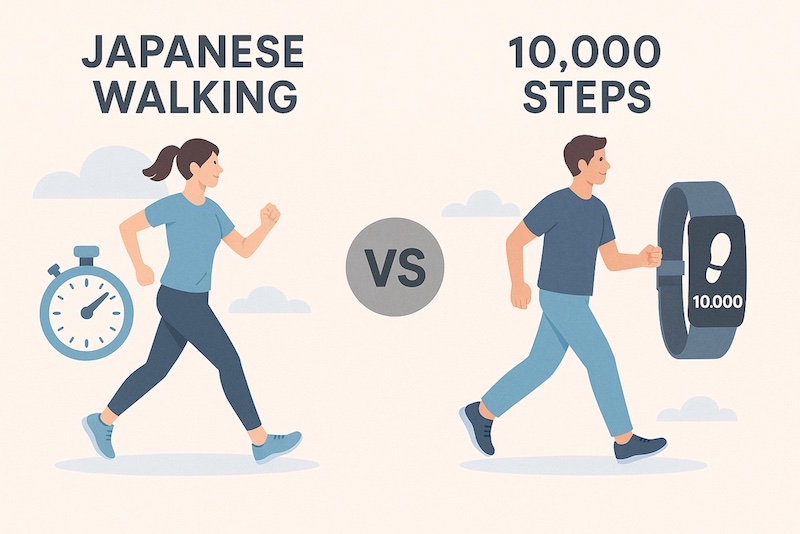
You do not need a smartwatch, chest strap, or heart-rate app to do Japanese walking well. One reason the method can feel approachable is that the intensity can be judged by plain old body signals: how hard you are breathing, how easily you can talk, how your legs feel, and how recovered you are by the end of each easy interval.
That said, “just go by feel” can be a little too vague. If you are not careful, your fast intervals turn into regular walking, and your easy intervals stay too hard. Then the workout gets less distinct and may not deliver the training effect you meant to get. So the real goal is not to be fancy. It is to be accurate enough.
Japanese interval walking usually means 3 minutes brisk, 3 minutes easy, repeated for about 30 minutes. In the original research, the harder segments were prescribed at a clearly challenging intensity and the recovery segments were deliberately easier. Without technology, you are estimating that effort rather than measuring it precisely, which is totally fine for most walkers. You just need consistent cues.
Short Answer: Use the Talk Test First, Then Double-Check With Effort and Recovery
If you want the fastest answer, here it is.
- During the fast 3 minutes, you should be able to speak only short phrases, not chat comfortably.
- During the easy 3 minutes, you should be able to speak in full sentences again by the end.
- Your fast intervals should feel around 6 to 7 out of 10 for effort, while the easy intervals should feel more like 2 to 4 out of 10.
- If your breathing never changes much, the fast pace is probably too easy.
- If you still cannot recover by the end of the easy interval, the fast pace was probably too hard.
The talk-test part of that system lines up well with CDC guidance on measuring exercise intensity, which uses speech and a 0 to 10 effort scale as simple ways to judge whether activity is moderate or vigorous. The exact RPE numbers in this article are best treated as practical coaching cues, not perfect official cutoffs. It is not lab-grade, obviously, but it is practical and surprisingly useful.
Why Measuring Intensity Matters in Japanese Walking
Japanese walking is not just “walk for 30 minutes and occasionally speed up a little.” The method is designed around a real contrast between the brisk intervals and the recovery intervals. If both paces feel the same, you are closer to continuous walking than interval walking.
That contrast is also what makes the routine practical. You do not have to jog. You do not have to hit a magical step count. You do not even need to know your heart rate. You just need your brisk intervals to feel meaningfully brisk and your recovery intervals to be genuinely easier.
If you are brand new to the method, our complete guide to Japanese walking explains the basic 3-minute fast and 3-minute easy structure before you start fine-tuning intensity.
The Talk Test Is the Best No-Tech Starting Point
The talk test is simple for a reason. During moderate activity, you can usually talk but not sing. During vigorous activity, talking gets chopped up and you cannot say more than a few words without pausing for breath. Japanese walking usually lives right around that line: your fast intervals should make full conversation annoying, while your easy intervals should let you settle down again.
For most people, that means the fast segments feel like “I could answer a question, but I do not want to tell a whole story right now.” If you can comfortably explain your weekend plans during the brisk portion, it is likely too slow. On the other hand, if you are gasping and counting down the seconds, you probably overshot the target.
This is also why so many readers like our more specific guide on setting your fast and slow pace using only your breath. Breath cues scale well even when your exact walking speed changes with weather, hills, age, or fitness level.
Use RPE So You Are Not Guessing Blind
The second tool is RPE, or rating of perceived exertion. That sounds technical, but it just means giving your effort a number. On a 0 to 10 scale, a useful target for many walkers is around 6 to 7 out of 10 during the fast intervals. Your easy intervals often feel more like 2 to 4 out of 10. That is hard enough to feel purposeful, but not so hard that the whole workout turns into survival mode.
Cleveland Clinic’s RPE overview gives a useful shorthand here: moderate effort sits around 4 to 5 out of 10 on the modified scale, while vigorous effort is around 6 to 7. For Japanese walking, that makes 6 to 7 a reasonable approximation for the work intervals, while the recovery intervals should feel easier and let you reset.
If you prefer the classic Borg scale, the fast intervals often feel roughly “somewhat hard” to “hard,” while the easy intervals sit closer to “very light” or “light.” You do not need to memorize any of that, though. The plain-language version works: brisk should feel tough but doable, and easy should actually feel easy.
Four Body Signals That Tell You If Your Pace Is Right
Talk test and RPE are the big two, but they work even better when you pair them with a few body signals.
- Breathing: During the fast interval, your breathing should noticeably deepen and speed up. During recovery, it should settle before the next hard round starts.
- Arm swing and stride intent: Your brisk pace usually comes with a more purposeful arm swing and a slightly quicker, more deliberate step rhythm. Not frantic. Just more committed.
- Leg sensation: Your calves, thighs, and glutes should feel like they are working during the fast portions. If the pace barely feels different from your usual walk, you are probably too slow.
- Recovery quality: By the last 30 to 60 seconds of the easy interval, you should feel ready to go again. Not perfectly fresh, but reset enough to repeat solid work.
That recovery point matters a lot. People often focus only on whether the fast interval feels hard enough. But if the easy interval never lets you recover, the next fast interval usually drops in quality. The method depends on repeating several solid rounds, not winning the first one and fading after that.
A Simple Self-Check You Can Use During Every Session
Here is a dead-simple no-tech script you can use while walking.
- Minute 1 of the fast interval: Ask, “Did I clearly change gears?” If not, speed up a notch.
- Minute 2: Try speaking one short sentence out loud. If it comes out too comfortably, you are still too easy.
- Minute 3: Rate your effort. Aim for about 6 to 7 out of 10, not an all-out 9.
- Minute 2 of the easy interval: Notice whether your breathing is beginning to settle. If not, make the next fast interval slightly less aggressive.
- End of the easy interval: Make sure you can talk normally again before the next brisk round starts.
That little check keeps you from drifting. Drift is common, by the way. Most people gradually let the fast pace soften, especially in the middle of the workout. Others make the recovery pace weirdly ambitious because they feel guilty slowing down. Both mistakes ruin the contrast.
If you want a fuller breakdown of what the brisk pace should feel like, this article on how fast to walk during Japanese walking can help you sharpen the difference between “brisk” and “just walking with confidence.”
Common No-Tech Mistakes That Throw Off Intensity
The most common mistake is picking a brisk pace based on ego. Maybe you choose the speed you think a fit person should handle, not the speed your body can repeat for five rounds. That usually ends with one good interval and four ugly ones.
The second mistake is never letting the recovery interval get easy enough. This one is sneaky. People worry that slowing down means they are wasting time, but the opposite is usually true. The easier walk is what allows the next brisk interval to be real.
The third mistake is ignoring terrain. A small hill, strong headwind, heat, or rough surface can push the same walking speed into a much harder effort zone. That is why body-based cues often beat fixed pace targets when you are outside. You are measuring how hard the work feels, not just chasing miles per hour.
And if you are just starting, give yourself permission to build gradually. Our 14-day beginner plan is useful because it teaches the rhythm first and lets intensity improve as your confidence catches up.
When You Should Be More Cautious
No-tech intensity checks are practical, but they are still subjective. If you take medications that affect heart rate, have cardiovascular or lung disease, or are recovering from illness, check with your clinician before starting or pushing brisk intervals. If walking brings on chest pain, fainting, severe shortness of breath, or symptoms that do not settle quickly with rest, stop exercising and get prompt medical evaluation. For some people, RPE is actually more useful than heart-rate targets, but the plan should still fit the medical reality.
For everybody else, the main rule is simpler: the brisk intervals should feel controlled, repeatable, and clearly harder than easy walking. They should not feel panicky.
The Bottom Line
The best way to measure Japanese walking intensity without technology is to combine the talk test, an RPE check, and a quick recovery check. During the brisk intervals, you should be limited to short phrases and feel like you are working at about 6 to 7 out of 10. During the easy intervals, your breathing should settle enough that normal conversation returns by the end.
That is accurate enough for most people, and honestly, it is often better than obsessing over gadgets you do not fully trust anyway. The goal is not perfect precision. The goal is a repeatable contrast between hard and easy that you can stick with week after week. If you can feel that contrast and recover on purpose, you are doing Japanese walking the way it is supposed to be done.