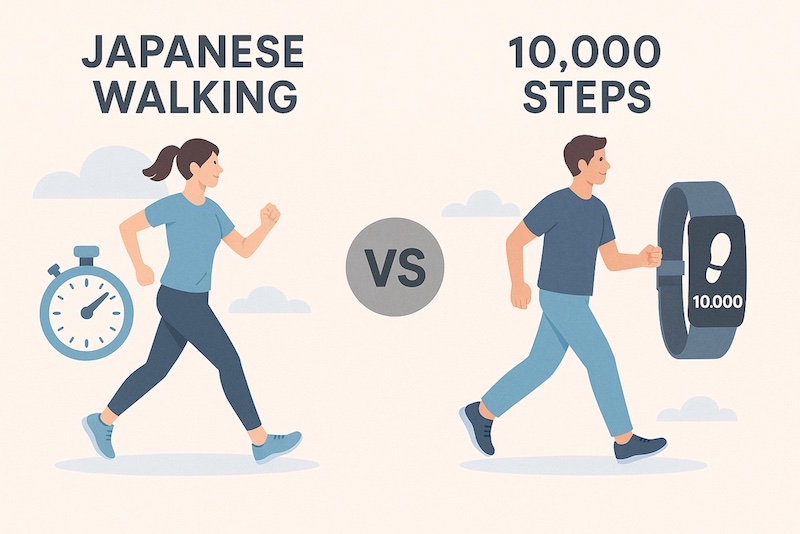
If you are looking at Japanese walking as a belly-fat fix, the honest answer is a little less flashy than the internet usually makes it sound. Yes, Japanese walking can absolutely help reduce body fat over time, including the deeper abdominal fat linked with metabolic risk. No, it does not selectively strip fat from your stomach just because the workout feels targeted or intense.
That distinction matters. Belly fat is usually a mix of subcutaneous fat, the softer fat under the skin, and visceral fat, the deeper fat stored around your organs. Visceral fat is the one doctors worry about most. It is strongly tied to cardiometabolic risk, and it tends to respond well to the same basic things that reduce overall body fat: steady training, enough weekly activity, and a routine you can actually repeat.
Japanese walking gives you a practical way to do that. You alternate 3 minutes of brisk walking with 3 minutes of easier walking for about 30 minutes. That sounds simple, and it is, but it also raises the training demand above a casual stroll. For a lot of adults, that makes it easier to accumulate enough intensity without running, hammering the joints, or turning every workout into a dramatic event.
Short Answer: Yes, It Can Help With Belly Fat, but Not by Spot-Reducing Your Stomach
If your real question is “Will Japanese walking help me reduce visceral fat linked with higher cardiometabolic risk if I stick with it?” the evidence says that is a reasonable expectation. If your question is “Will this one walking method specifically melt fat off my belly faster than the rest of my body?” that is where the answer turns into no.
Mayo Clinic explains that abdominal exercises alone do not get rid of belly fat, and that visceral fat responds to the same diet-and-exercise habits that lower total body fat. That lines up with the exercise literature pretty well. Walking can help. Interval walking may help more than steady easy walking in some groups. But the mechanism is still overall fat loss and improved metabolic health, not magic local fat burning.
Why Japanese Walking Is a Legit Option for Fat Loss
Japanese walking is not just “walking, but with better branding.” It is a structured interval method, often called interval walking training, built around repeated shifts in effort. During the brisk segments, you work hard enough that conversation gets choppy. During the recovery segments, you back off enough to reset before the next round.
That contrast is useful because it lets many people spend more total time at a meaningful intensity than they would in a flat, one-speed walk. Research on interval walking has shown improvements in aerobic fitness, blood pressure, leg strength, and body composition in populations that matter to normal readers, especially middle-aged and older adults and adults with metabolic issues.
If you are new to the method itself, our complete guide to Japanese walking breaks down the original 3-minute fast and 3-minute easy structure and how hard the brisk intervals are supposed to feel.
What the Research Actually Suggests About Belly Fat
The most useful finding here is not that one quirky trick torches belly fat. It is that walking and interval-style exercise can reduce visceral fat over time when people do enough of it consistently.
Research on walking and interval-style exercise suggests that consistent training can help reduce visceral fat over time, even when weight loss is not dramatic. Studies on interval walking have also shown improvements in fitness and body composition in some adults, which is a big part of why the method gets attention in the first place. That does not mean every person will see dramatic waist changes right away, but it does support the basic idea that structured walking can move the needle.
Broader reviews point the same direction. Exercise training, especially aerobic-style work, has been shown to reduce visceral fat even when total weight loss is modest. That is important because some people quit too early when the scale does not perform like a game show reveal. Belly-fat improvement and metabolic improvement can start happening before you see huge cosmetic changes.
If the calorie side of this still feels fuzzy, our guide to Japanese walking for weight loss explains why the method can support fat loss without needing a perfect calorie-burn estimate from a watch.
What Japanese Walking Can and Cannot Do for Your Midsection
Here is the practical version.
- It can help you burn more energy than an easy stroll.
- It can improve fitness, which usually makes it easier to sustain more weekly activity.
- It may help reduce visceral fat over time as part of overall fat loss.
- It cannot guarantee that your belly is the first place fat comes off.
- It cannot outwork a routine that consistently overshoots calories, wrecks sleep, or never happens often enough.
That last one is the boring truth, but it matters. Fat distribution is influenced by age, sex, hormones, genetics, medications, and total lifestyle habits. Two people can follow the same walking plan and lose fat in a different order. One notices the waist first. Another sees face and hips change before the belly budges. That is normal, not failure.
And if you are comparing interval walking with harder protocols, our article on Japanese walking vs. HIIT for fat loss explains why harder is not always better once consistency enters the chat.
How to Make Japanese Walking More Effective for Belly-Fat Goals
If your goal is less belly fat, the routine needs to be structured enough to matter. A few things usually help.
- Use real brisk intervals. The fast segments should feel clearly harder than your easy pace. If you can sing through them, they are probably too soft.
- Do it often enough. Public-health guidance from the CDC recommends at least 150 minutes of moderate-intensity aerobic activity per week, or 75 minutes of vigorous activity, plus muscle-strengthening work. Japanese walking can help you cover part of that target in a more focused way.
- Keep the sessions repeatable. Four hard days you hate are usually less useful than three or four sessions you can keep doing for months.
- Pair it with sane nutrition. You do not need a weird detox. You do need an eating pattern that does not erase the energy deficit your walking is trying to create.
- Track more than weight. Waist measurements, walking pace, recovery, and how your clothes fit can tell a fuller story than the scale alone.
If you are not sure how many sessions make sense, our guide on how often to do Japanese interval walking gives a realistic weekly rhythm instead of the usual all-or-nothing nonsense.
When Results Usually Show Up
This is where expectations can go sideways. Belly fat usually changes more slowly than people want, and visible waist changes often lag behind early fitness improvements. You may notice that the brisk intervals feel easier, your breathing settles faster, or your daily walks stop feeling like a chore before your midsection looks different.
That does not mean the process is not working. It usually means your body is adapting before the mirror catches up. If you want a realistic short-term frame, our article on what to expect after 30 days of Japanese interval walking can help you judge progress without expecting a miracle.
So, Does Japanese Walking Really Work for Belly Fat?
Yes, Japanese walking can really work for belly fat in the sense that it can help reduce overall and visceral abdominal fat as part of a consistent exercise routine. That is the evidence-based answer.
What it does not do is override the normal rules of fat loss. It is not spot reduction. It is not a shortcut around consistency. It is not guaranteed to flatten your stomach in two weeks because a headline said so.
But if you want a lower-impact, research-backed way to make walking more effective, Japanese walking is a very solid tool. It raises the training signal without forcing you into running. And for a lot of people, that is exactly why it works well enough to stick.