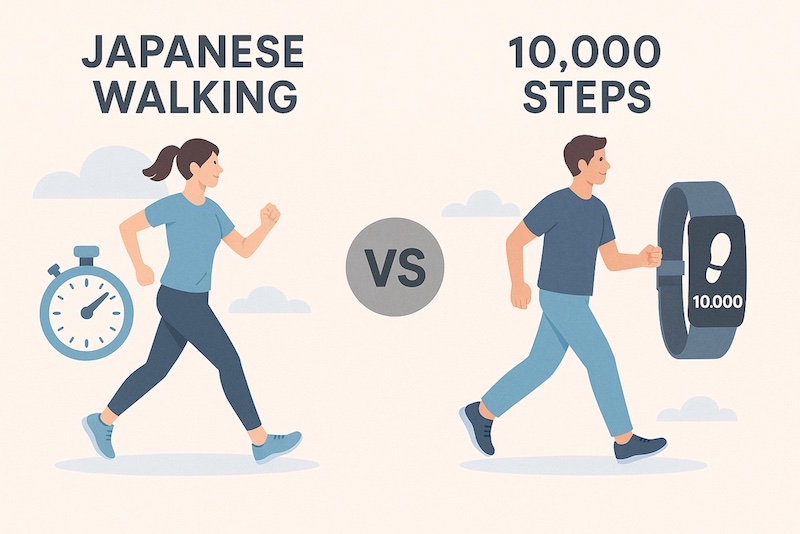
The short answer is this: your fast intervals should feel clearly brisk, not casual, but they still should not turn into jogging. In the original Japanese interval walking research, the hard blocks were set above 70% of peak aerobic capacity, which is a fancy way of saying the brisk pace was meant to feel meaningfully challenging for the person doing it. That means there is no single miles-per-hour number that fits everybody. In practice, a useful brisk pace is one that makes you breathe harder, makes full conversation less comfortable, and still lets you recover enough to repeat the next round well.
If you are new to the method, start with our complete guide to Japanese walking first. It lays out the classic 3-minutes-brisk, 3-minutes-easy rhythm. This article is about the pace question specifically, because honestly, that is where most people either undershoot the workout or make it way too hard for no good reason.
The biggest mistake is assuming “fast” means the fastest walk you can survive for three minutes. That is not the goal. A good brisk interval should feel purposeful and a little uncomfortable, sure, but still controlled. You are trying to create a repeatable contrast between the work block and the recovery block. If the fast pace wrecks your form, makes you want to jog, or leaves you unable to settle during the easy interval, it is probably too much.
What the original Japanese walking research actually meant by “fast”
The best-known Shinshu University protocol used repeated 3-minute fast and 3-minute slow intervals, typically targeting five or more sets per day on four or more days per week. The fast walking segments were set above 70% of peak aerobic capacity for walking, while the easy segments were around 40%. You can see that structure in the original Mayo Clinic Proceedings study on interval walking training. That protocol matters because it tells us the brisk interval was supposed to be real exercise, not just “walking a bit less lazily than usual.”
At the same time, the study did not tell everyone to walk at one universal speed. Taller people, shorter people, fitter people, older beginners, and people walking on different terrain will all hit that effort zone at different paces. So if somebody online says Japanese walking only counts at 4 mph, 4.5 mph, or some other clean number, that is already too rigid for how the method was actually designed.
That is why experienced walkers usually do better when they think in terms of effort first and numbers second. Pace can help you repeat a good workout later. It should not be the first boss of the workout.
Use the talk test before you use a treadmill number
If you want the simplest practical rule, use the talk test. The CDC explains exercise intensity this way: at moderate intensity, you can talk but not sing, and at vigorous intensity, saying more than a few words gets hard. For Japanese interval walking, that can serve as a practical approximation of the kind of relative effort the brisk interval is aiming for. As a rule of thumb, many walkers will find that a useful brisk block allows only short phrases, while a relaxed full conversation starts feeling less comfortable.
That is a much better guide than obsessing over smartwatch pace on day one. If you can chat comfortably through the whole fast block, you may be too slow for this method. If you are gasping, losing posture, or tempted to break into a jog, you may be too fast for this session. The sweet spot sits in the middle: challenged, warmer, more breathy, but still walking with control.
If pacing by feel still sounds vague, our guide on setting your fast and slow pace using only your breath helps a lot. That breathing shift is basically the whole trick. Get that right and the method starts making sense fast.
What “fast enough” feels like in real life
A correct brisk interval usually feels like this: your arm swing gets a bit sharper, your stride stays natural instead of overreaching, your breathing picks up within the first minute, and by the final minute you know you are working. You should still feel stable. You should still feel like a walker. But you should not feel like you are out for a relaxing stroll anymore.
Your easy interval, on the other hand, should feel genuinely easier. That is important. If the slow block does not let your breathing settle at least a little, the fast block was probably too aggressive for this session. Japanese interval walking works because you can repeat quality brisk efforts several times, not because you survive one monster interval and then spend the rest of the workout hanging on.
Quite a few people notice they were walking too easy when their fast and slow paces barely feel different. That is common, especially if the person is trying too hard to stay “sustainable.” On the flip side, some beginners overshoot by treating the brisk interval like a power-walking race. If your shoulders tense up, your steps get choppy, or you cannot keep the same effort by the fourth or fifth round, back off a little. Repeatable effort beats dramatic effort.
Can you use steps per minute or mph?
You can, but treat those numbers like rough checkpoints, not laws. Research on walking cadence often uses about 100 steps per minute as a practical marker of moderate intensity for many adults, but that is a broad walking heuristic, not a specific Japanese interval walking target. Some people will need more than that to make the brisk interval feel truly challenging. Others, especially older adults or people with lower current fitness, may reach a useful effort at a lower pace or lower cadence. Body size, stride length, terrain, weather, and treadmill settings all change the picture.
That means a treadmill readout can be helpful only after you have already found a good effort level. Once a pace feels right, save the number. Reuse it. Adjust from there. But do not let the machine talk you into a speed that makes your walking mechanics sloppy just because somebody online posted a cooler number.
If you want the broader research background behind those brisk intervals, our article on the science behind Japanese interval walking explains why the harder walking time matters so much. The short version is that the fast blocks are the engine of the method, but only when they are hard enough to matter and controlled enough to repeat.
How to find your own brisk pace in the first week
A simple starting method works well for most people:
- Walk easy for 5 minutes to warm up.
- For your first brisk block, increase pace until your breathing clearly rises but you are still walking smoothly.
- By minute two, check whether you could only speak in short phrases.
- By minute three, ask whether the effort still feels controlled enough that you could repeat it four more times.
- During the easy block, slow down enough that your breathing starts settling before the next brisk round.
If that feels too hard by round two, lower the brisk pace a notch. If it still feels comfy by round five, raise it a notch next session. It does not need to be more complicated than that. In the first week, your job is not to find a perfect number. Your job is to learn the contrast.
If you are very new to exercise, older, or coming back after a long break, it is fine to start below the full classic workout. Fewer rounds or a slightly milder brisk pace can still teach the rhythm. Our 14-day beginner plan is a better entry point than trying to force the full version immediately.
Signs your brisk pace is wrong
Your brisk pace may be too slow if the fast and easy blocks feel almost the same, your breathing barely changes, and the session stays fully conversational the whole time. It may be too fast if you start half-jogging, cannot recover during the easy intervals, or your pace crashes hard after the first couple of rounds.
The best brisk pace usually feels a bit boring in the most useful way. It is not flashy. It is just honest. You can repeat it, it raises effort clearly, and it makes the final interval feel like work without turning the workout into chaos.
Once you have that dialed in, the bigger question becomes how often to repeat the sessions each week. Our article on how often to do Japanese interval walking helps with that part. Frequency matters because even a well-paced interval session only pays off if you do it consistently.
Bottom line
So, how fast should you walk during Japanese interval walking? Fast enough that the brisk blocks feel clearly challenging, raise your breathing, and limit talking to short phrases, but not so fast that you need to jog or cannot recover for the next round. That is the real answer. For this method, the right pace is individual, but the right effort is not random at all.
If you keep the fast intervals honest and the easy intervals truly easy, your workout becomes much more consistent with how Japanese interval walking was actually studied. Not as a vague “walk a bit quicker” idea, but as an actual training rhythm you can repeat week after week.