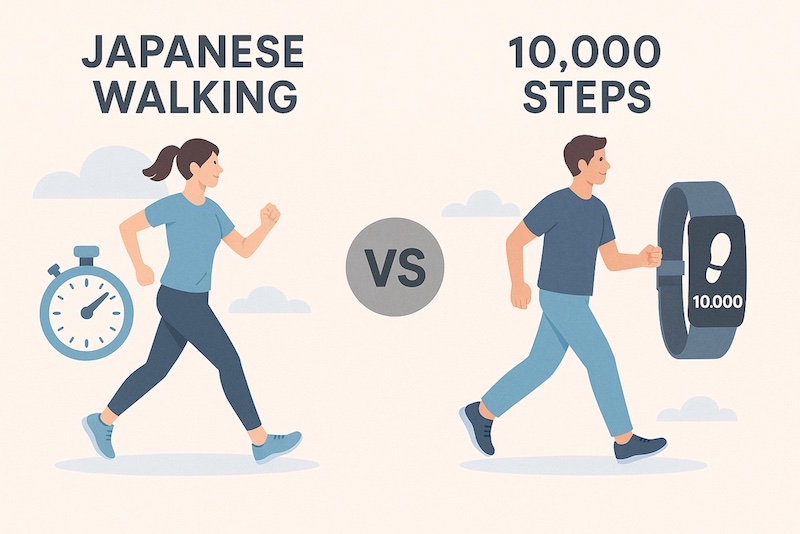
If you are trying to lose body fat, it is easy to assume HIIT wins by default. It sounds tougher, sweatier, and a lot more dramatic than walking. On paper, that makes sense. In real life, the answer is not that clean.
Japanese walking, also called interval walking training, alternates 3 minutes of brisk walking with 3 minutes of easier walking for about 30 minutes. HIIT usually means shorter bursts of much harder effort, often with running, cycling, rowing, or bodyweight work. Both use intervals. They just live at different intensity levels.
So which one burns more fat? If we mean long-term body fat loss, the current evidence does not support a simple “HIIT always wins” answer. In fact, that is where things get interesting.
Short Answer: HIIT Is More Intense, but It Does Not Clearly Produce More Fat Loss Overall
HIIT is usually performed at a higher intensity than Japanese walking, but the sources reviewed for this article do not directly compare their per-minute calorie burn. What they do show is that when researchers compare HIIT with continuous aerobic training over weeks and months, HIIT does not consistently produce greater body-fat loss. A 2023 systematic review and meta-analysis found that HIIT was not superior to continuous aerobic training for reducing body fat percentage or visceral fat in adults with excess weight.
That matters here because Japanese walking is not random casual walking. It is an interval method. And in walking-specific studies, interval walking has shown better improvements in body composition than steady continuous walking in some groups. So if your real question is “which routine is more likely to help me lose fat and actually stick,” Japanese walking can be a very strong option.
Why “Burns More Fat” Is a Slippery Question
People use the phrase “burns more fat” in at least three different ways:
- Calories burned during the workout
- Fat used as fuel during and after the workout
- Actual changes in body fat over time
Those are not the same thing. A workout can look impressive in a single session and still fail to outperform a simpler program in long-term body-composition studies. That is one reason fat-loss research often ends up less dramatic than fitness marketing.
If you are still getting familiar with the structure of interval walking, our complete guide to Japanese walking breaks down exactly how the 3-and-3 rhythm works and why it feels harder than a normal stroll.
What the Research Says About Japanese Walking and Fat Loss
The strongest point in Japanese walking’s favor is that it has research on an actual walking-based interval protocol, not just generic cardio advice. In a 2011 study from Japanese researchers, middle-aged and older adults who performed interval walking for 4 months improved aerobic fitness and thigh strength while also lowering body weight, BMI, body fat percentage, blood pressure, and blood glucose. The changes were especially strong in those who started less fit.
Another randomized trial in adults with type 2 diabetes compared interval walking with energy-matched continuous walking. The interval-walking group improved fitness and reduced fat mass and visceral fat, while the continuous-walking group did not show the same body-composition improvement. That does not prove Japanese walking beats every form of exercise. Still, it does show this style of walking can do more than just help you “get steps in.”
If fat loss is your main goal, that is a pretty practical takeaway. Japanese walking gives you a way to push intensity without leaving the walking category. For people who prefer walking-based exercise, that may make the method easier to use consistently.
If you want a deeper look at the calorie side of the equation, our article on Japanese walking for weight loss and calorie burn explains why pace contrast matters more than chasing one magic number.
What HIIT Does Better
HIIT still has real advantages. It is a more aggressive training tool. It often improves cardiorespiratory fitness quickly, and some studies show stronger gains in VO2 max than moderate continuous training. If you are fit enough to train hard, recover well, and stay consistent, HIIT can be extremely time-efficient.
It also gives you more ways to raise intensity. Running sprints, cycling intervals, hill repeats, or hard rowing are usually capable of reaching higher peaks than brisk walking. That can make HIIT appealing for people who enjoy performance-oriented training or who simply get bored with lower-impact cardio.
But the fat-loss story is still more modest than the hype. Multiple reviews have found that HIIT is often similar, not clearly better, than other aerobic training for reducing body fat. In plain English: HIIT can work very well, but it is not some automatic fat-melting cheat code.
There is also a practical issue. Because HIIT is vigorous by definition, it needs to be scaled to the person doing it. Cleveland Clinic’s overview of how to ease into HIIT safely makes this point well: intensity should be relative, warm-ups matter, and beginners should ramp up instead of going full maniac on day one.
Who Usually Does Better With Japanese Walking
Japanese walking may be a strong option if you:
- prefer a walking-based interval workout
- are new to exercise or returning after time off
- have enough fitness to walk briskly but not enough to sprint comfortably
- identify more with the populations studied so far, such as older adults or adults managing metabolic health issues
- care as much about consistency as you do about training intensity
That last point is huge. Consistency matters for long-term results. If you are still building the habit, our 14-day beginner plan is a gentler on-ramp than jumping straight into hard intervals everywhere.
And if you are wondering how often to use the method for fat loss, our guide on how often to do Japanese interval walking lays out a realistic weekly target without turning the plan into a second job.
Who Might Prefer HIIT Instead
HIIT may be the better fit if you already tolerate vigorous exercise well, enjoy hard training, and want the biggest cardiovascular challenge you can recover from. It can also make sense if you have limited time and prefer very short, intense sessions over longer walks.
Just do not confuse “harder” with “better for everyone.” A routine only helps if you can keep doing it. That sounds obvious, but it gets lost fast once exercise advice turns into a toughness contest.
Best Choice for Fat Loss: The One You Can Repeat
If you want the cleanest evidence-based answer, here it is: HIIT does not clearly beat other cardio methods for body-fat loss across long-term research. Japanese walking, meanwhile, has direct interval-walking evidence showing meaningful improvements in fitness and body composition in the groups that have been studied.
So for many adults, especially those who prefer walking-based exercise, Japanese walking may be a practical way to use intervals for fat-loss goals. For fitter people who genuinely enjoy vigorous training, HIIT can absolutely work too. It is just not magic.
If you want a simple starting rule, begin with a structured plan you can repeat consistently before assuming you need something harsher. Fancy is overrated sometimes.